All 28 callouts on the official map, rotating doors, wall and silent drop explained, the patch 12.05 rework, the pro meta with real numbers and tips for three sites – plus a callout quiz.
New to Valorant? The app has your backLocker value in VP & euros and a coach with heatmaps – ideal alongside “Lotus guide”, 100% local, no login, free.
The official Lotus minimap from the Valorant API shows all 28 callouts in their real position. Tap your way around the map or test yourself in the callout quiz – so the names stick before your next match.
1Tap a dot or a name – the map shows the area and nearby callouts.
2Use the filters and “All names” to learn one area at a time.
3“Start quiz”: 10 random callouts, you tap the right spot.
What the map does for you
You make precise callouts in matches instead of “one back there”.
You understand where rotations run and which areas connect.
The quiz trains fast recall – exactly what counts in a match.
All positions come from the official map – no made-up names.
Tip: combine “All names” with a filter for one side to learn Lotus fastest – start with the side you play most, then the rest.
⚡ Quick answer
Lotus is a Valorant map with three spike sites (A, B and C), set in the Western Ghats in India. The official map has 28 callouts – more than either of the other two maps in this guide. Its defining features are the two rotating doors that turn 180 degrees in 10 seconds, a destructible wall between A Main and A Link and a silent drop at A. Lotus has been back in the map pool since patch 12.05 with a reworked A site. In pro play, Omen, Viper and Fade are the pillars.
How to use the interactive Lotus map
Above you see the official Lotus minimap from the Valorant API with all 28 callouts exactly where the game places them. Tap a dot or a name: the map shows the area and neighboring callouts. Use the filters to show only A, B, C or the spawns – Lotus has no classic mid. “All names” labels the entire map – with 28 callouts, the fastest way to get an overview.
The callout quiz tests you on ten random callouts. On Lotus that pays off twice: many names like A Root, A Rubble, C Mound or C Bend aren’t memorized even by experienced players. For all 13 maps, there’s the full callout trainer.
Lotus at a glance
Official Lotus splash artwork (source: Valorant API)
Property
Value
Release
January 10, 2023 · patch 6.0 (Episode 6, Act 1)
Setting
“City of Flowers”, Western Ghats, Karnataka, India
Spike sites
3 (A, B and C)
Callouts
28 (official map)
Special feature
2 rotating doors (180° in 10 s), destructible wall (400 HP), silent drop, rope at A
Ultimate orbs
2 – A Main and C Mound
In the pool
Yes – since patch 12.05 (March 17, 2026), with an A-site rework
Lotus released on January 10, 2023 with patch 6.0 as the ninth standard map and the second three-site map after Haven. According to Riot, a mysterious structure houses an astral conduit radiating ancient power; great stone doors unlock the paths to three mysterious sites. The setting is the “City of Flowers” in the Western Ghats in the Indian state of Karnataka, and the map’s internal codename was “Jam”.
The development story described by the Valorant Wiki is fascinating: Lotus was originally planned as a three-site space station where one site would be locked each round. That felt frustrating in testing. The rotating doors were created as a replacement – inspired by the rotating fireplace scene in “Indiana Jones and the Last Crusade”.
Lotus mechanics: rotating doors, wall, drop and rope
Lotus has more map mechanics than any other map in this cluster. All values come from the official Valorant Wiki.
The two rotating doors
One rotating door sits between A Main and A Tree (on the map: A Door), the other between C Mound and B Main (on the map: C Door). You activate them with a switch from either side. The door then turns 180 degrees in 10 seconds – before patch 8.0 it took 8 seconds. The rotation is loud and audible to everyone nearby. That’s exactly what makes the doors tactical: you open a new path, but you also give away that someone is there.
For attackers, the doors open fast rotations between A and B or B and C. Defenders use them to rotate unexpectedly or to delay an attack. Above all, learn what you can see from the door once it’s open – many duels on Lotus are decided in exactly that moment.
The destructible wall at A
Between A Main and A Link stands a destructible wall with 400 HP. Its color shows its state: blue intact, yellow damaged, red about to break. Intact, it blocks gunfire; destroyed, it opens a passage. Attackers like to break it to create a second route toward A, while defenders keep an eye on it, because a new path also means a new flank.
The silent drop and the rope at A
From A Top you can drop down to A Drop. If you walk off without running and land correctly, your footsteps stay silent – a strong surprise route onto A site. To get back up, use the rope that runs from A site up to A Top.
Ultimate orbs
Lotus has two ultimate orbs: one in A Main and one on C Mound. The former orb at B was removed with patch 8.0.
Lotus rule of thumb: doors are loud, the drop is silent, the wall is a path on demand. Master these three things and you’ll play Lotus a class above your opponents.
All 28 Lotus callouts explained
The table lists every Lotus callout from the official map with its area and the three spatially closest callouts. Lotus has no classic mid – B is the central site, with A and C on the outside.
Callout
Area
Nearby
A Door
A side
A Tree, A Main, A Rubble
A Drop
A side
A Top, A Hut, A Site
A Hut
A side
A Site, A Top, A Drop
A Link
A side
B Site, B Upper, A Root
A Lobby
A side
A Root, B Pillars, Attacker Spawn
A Main
A side
A Door, A Rubble, A Root
A Root
A side
A Main, A Rubble, A Lobby
A Rubble
A side
A Main, A Door, A Root
A Site
A side
A Hut, A Tree, A Top
A Stairs
A side
A Top, A Hut, A Site
A Top
A side
A Drop, A Hut, A Stairs
A Tree
A side
A Door, A Site, A Main
B Main
B side
B Pillars, B Site, C Door
B Pillars
B side
B Main, Attacker Spawn, C Mound
B Site
B side
A Link, B Upper, B Main
B Upper
B side
B Site, A Link, Defender Spawn
C Bend
C side
C Site, C Main, C Hall
C Door
C side
C Mound, C Main, B Main
C Gravel
C side
C Link, C Waterfall, C Hall
C Hall
C side
C Site, C Bend, C Waterfall
C Link
C side
C Waterfall, C Gravel, B Site
C Lobby
C side
Attacker Spawn, C Mound, B Pillars
C Main
C side
C Door, C Site, C Waterfall
C Mound
C side
C Door, B Main, C Main
C Site
C side
C Hall, C Bend, C Main
C Waterfall
C side
C Link, C Main, C Door
Attacker Spawn
Attacker spawn
B Pillars, C Lobby, A Lobby
Defender Spawn
Defender spawn
B Upper, A Stairs, A Top
A side: the long route with door, wall and drop
With 12 callouts, the A side is the biggest. Attackers come from A Lobby through A Root into A Main. There the path splits: through A Rubble and the rotating door A Door toward A Tree and onto A Site, or through the destructible wall into A Link toward B. On site stands A Hut, with A Top and A Drop above it. A Stairs leads toward defender spawn.
B side: the central site
B sits in the middle of the map and has only four callouts. From the attacker side you reach B Site through B Pillars and B Main. Above it is B Upper, toward defender spawn. Because B lies between A Link and C Link, the site is the hub for rotations.
C side: Mound, Waterfall and Bend
Attackers start from C Lobby and move over C Mound – home of the rotating door C Door toward B Main – into C Main and onto C Site. To the left of the site is C Bend, with C Hall behind it. On the defender side, C Waterfall and C Link connect the site to B, and C Gravel sits further up toward defender spawn.
Is Lotus in the map pool? Rotation and the 12.05 rework
Yes. Lotus has been back in rotation since patch 12.05 (March 17, 2026) and is also part of the pool used for Competitive since patch 13.04 (August 18, 2026): Ascent, Abyss, Haven, Lotus, Split, Summit and Sunset. Before that, Lotus had been rotated out with patch 11.08 in October 2025 – and it had also been out of the pool once before.
For its return, Riot reworked the A side according to the official patch notes 12.05:
The attacker lobby wall was thickened to remove wall penetration after a barrier drop.
The jump up to Vines was moved to help attackers get out of Lobby and avoid utility dumps.
The wall outside of Tree room was reinforced and can no longer be wallbanged.
An extra room was added outside of the A site stairs so defenders can hold A further back.
The A site plant zone was changed so you can no longer plant for the breakable/Link side.
Patch 8.0 had already changed Lotus significantly: A Main, A Link, A Hut, B Site, C Site and C Bend were adjusted, the rotating doors were slowed down and the B orb was removed. You’ll find the current status of all maps on our Valorant maps & map pool overview.
Lotus pro meta: who gets picked
The presence values show in what percentage of maps an agent was picked by at least one team. The source is our pick rate overview (vlr.gg, VCT 2026 Americas Stage 2, 150 maps played).
Presence = share of pro maps played on Lotus in which at least one team picked the agent · data: vlr.gg, VCT 2026 Americas Stage 2 (150 maps in total)
Omen is locked in at 100%, Viper follows at 85% and Fade at 79%. Three sites and many wide angles call for two controllers and a strong info initiator. Behind them come Raze (65%) as entry and Vyse (59%) as sentinel – making Lotus one of the few maps where a sentinel is almost standard in pro play. Neon follows at 41%.
Lotus: Most-played pro comp (9 of 37) · source: vlr.gg, VCT 2026 Stage 2 (4 regions) + Champions 2026
The most-played pro comp on Lotus is Raze, Fade, Omen, Viper, Vyse – 9 of 37 recorded comps (source: vlr.gg, VCT 2026 Stage 2 across four regions plus Champions 2026). Omen and Viper cover the wide angles, Fade brings the information, Raze opens the site, and Vyse locks down the flank and post-plant with Razorvine and Shear. Test your own ideas in the team comp builder.
Attacking on Lotus: tips for the attacker side
For attackers, three sites mean one thing above all: the defense is spread thin. Gather information fast, commit decisively, and you’ll almost always find a weak site.
Get early information: Fade’s Haunt or Prowler shows you how many defenders are holding a site. On Lotus, that info decides which site you hit.
Use doors as fakes: a rotating door is loud. Activate it deliberately to bait the defenders into rotating – then hit the other site.
Hit A from two routes: pressure through A Main and Rubble, plus optionally the destructible wall to Link. That forces A defenders to hold several angles at once.
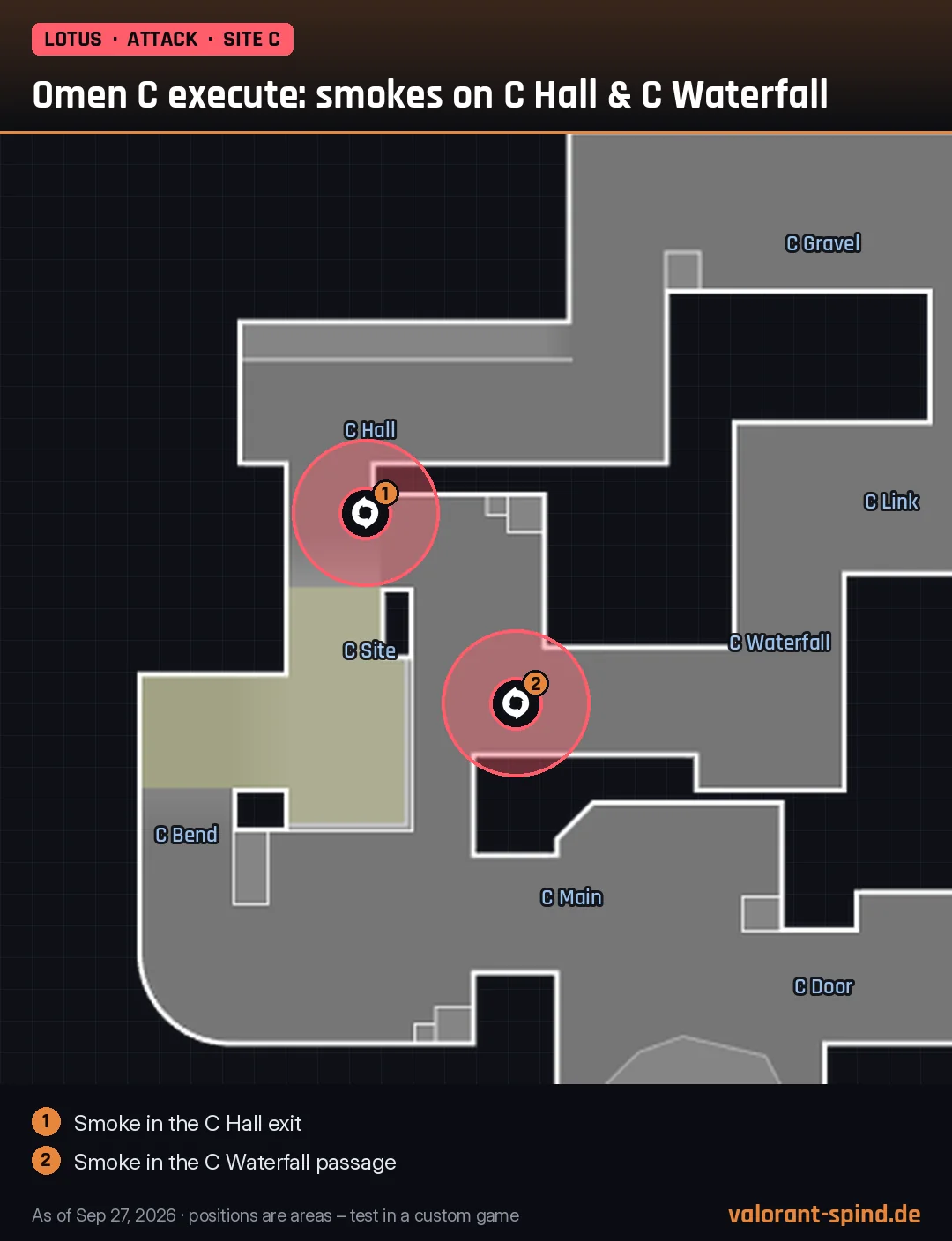
Hit C through Mound and Main: on C, a grouped hit with smokes on the defender side – toward C Waterfall and C Hall, for example – keeps rotations from B out of your way.
Post-plant with sentinel utility: as the pros show, Vyse or Chamber are valuable on attack too – they lock the flank and the spike after the plant.
On Lotus, the team that rotates faster often wins. Use the rotating doors to be on the other site within seconds after a fake. Practice these plays on the strategy board – with three sites, a clear plan for every round pays off.
A classic is the silent A take: one player uses the silent drop from A Top while the rest pressure through A Main. The A defenders end up looking the wrong way. But keep the plant zone in mind since patch 12.05 – plants for the breakable/Link side are no longer possible at A.
Defending on Lotus: tips for the defender side
Holding three sites with five players is the biggest challenge on Lotus. The answer is information and rotation.
Information at every site: without a camera, tripwire or alarm, you can’t see where the attack is coming. Sentinels like Vyse, Cypher or Killjoy are worth their weight in gold here.
B as the hub: one player at B can rotate to both outer sites via A Link and C Link. Lose B early and your defense falls apart.
Listen for the doors: every rotation is audible. A turning door doesn’t automatically mean an attack – but it’s always information.
Use the A rework: since patch 12.05 there’s an extra room outside the A stairs. From there you can hold A further back instead of fighting early at Rubble.
Retake together: because the routes between sites can be long, group up before a retake. Players arriving one by one lose to a well-set post-plant.
Watch the drop: the silent drop from A Top to A Drop is a surprise route. As an A defender, keep it in mind – an attacker can land there without making a sound.
Lotus setups: Vyse & Omen smokes for all three sites
Here are the key Lotus setups to copy – no video needed: every position is marked on the official minimap, numbered and explained step by step. The agents are the ones actually played on Lotus in VCT 2026: Omen (100% presence) and Vyse (59%) – for all three sites.
Every Lotus setup on this page is backed by at least two matching sources. Pick a setup on the map – it zooms straight to the right spot. Important: the markers show the area, not the exact pixel. Since patch 12.05 reworked the A side, try the A setups in particular once in a custom game before you use them in ranked.
Geometry: patch 12.05 (Mar 17, 2026) reworked only the A side (cubby at A Stairs, smaller plant zone); B and C are unchanged since patch 8.0, and the A setups rely on sources from before 12.05. Agents picked by VCT 2026 presence on Lotus (vlr.gg): Omen 100% and Vyse 59%; Viper (85%) is missing because no wall line is documented precisely enough.
Vyse A setup: Shear & Razorvine in A Main, Arc Rose in Tree
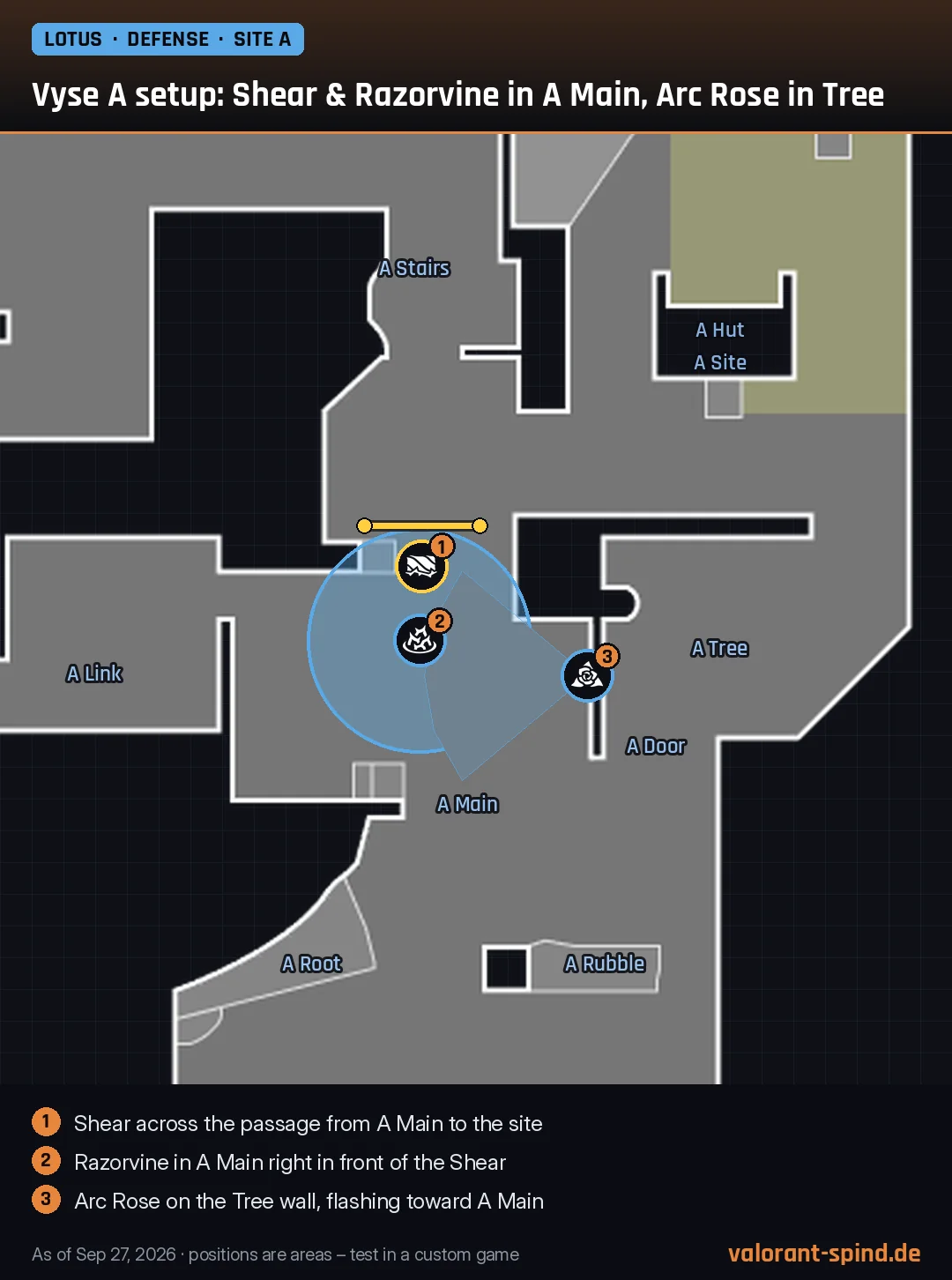
1Shear: Place the Shear across the passage attackers use to walk from A Main onto the site. Whoever crosses it triggers the wall behind them and faces you alone.
2Razorvine: Throw the Razorvine right in front of it in A Main. Activate it as attackers approach the Shear – they are slowed and take damage.
3Arc Rose: Put the Arc Rose in Tree on the wall that borders A Main – it can be placed through the wall. Activate it as soon as enemies stand in A Main.
+Tip: Since patch 12.05 there is a new cubby at A Stairs that lets you hold A further back – a good spot to shoot from after the flash. Try the setup once in a custom game.
Covers: The direct route from A Main onto the site – isolate, slow and flash in one.
Weak spot: Attackers bypass the Shear via the rotating door (A Door) and Tree. The sources predate the A rework in patch 12.05 – check the spots in a custom game.
1Shear: Place the Shear right in the narrow choke attackers use to enter B Site from B Main. The wall cuts the first player off from the rest of the team.
+Tip: B Main is the only attacker entrance onto B – both sources put the Shear here. They place the Razorvine differently (in front of the Shear in B Main or on the default plant); use it to delay or to deny the plant, depending on the enemy.
Covers: The only direct attacker entrance onto B.
Weak spot: Attackers who rotate through A Link or C Link take the site from the side – the Shear does not help there.
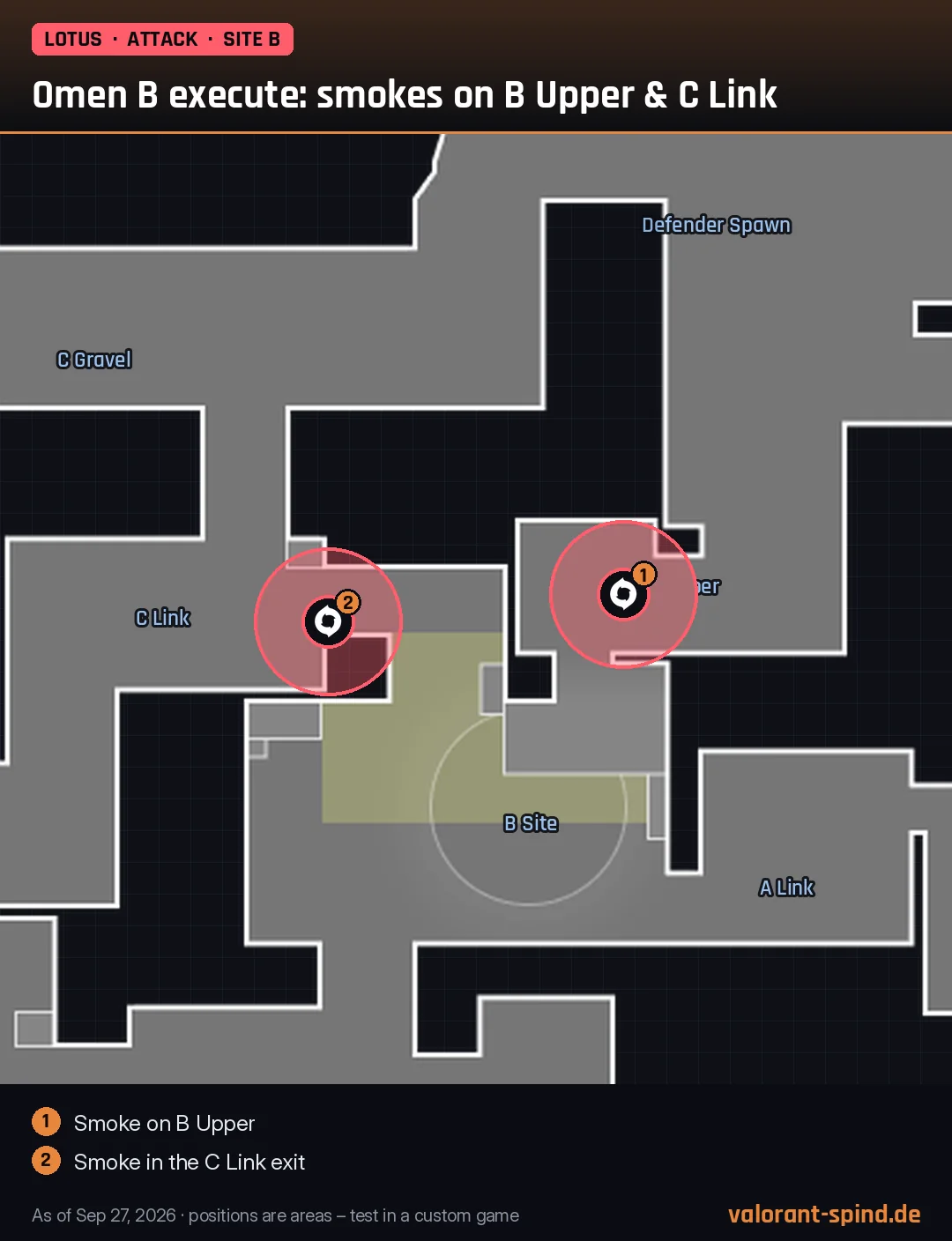
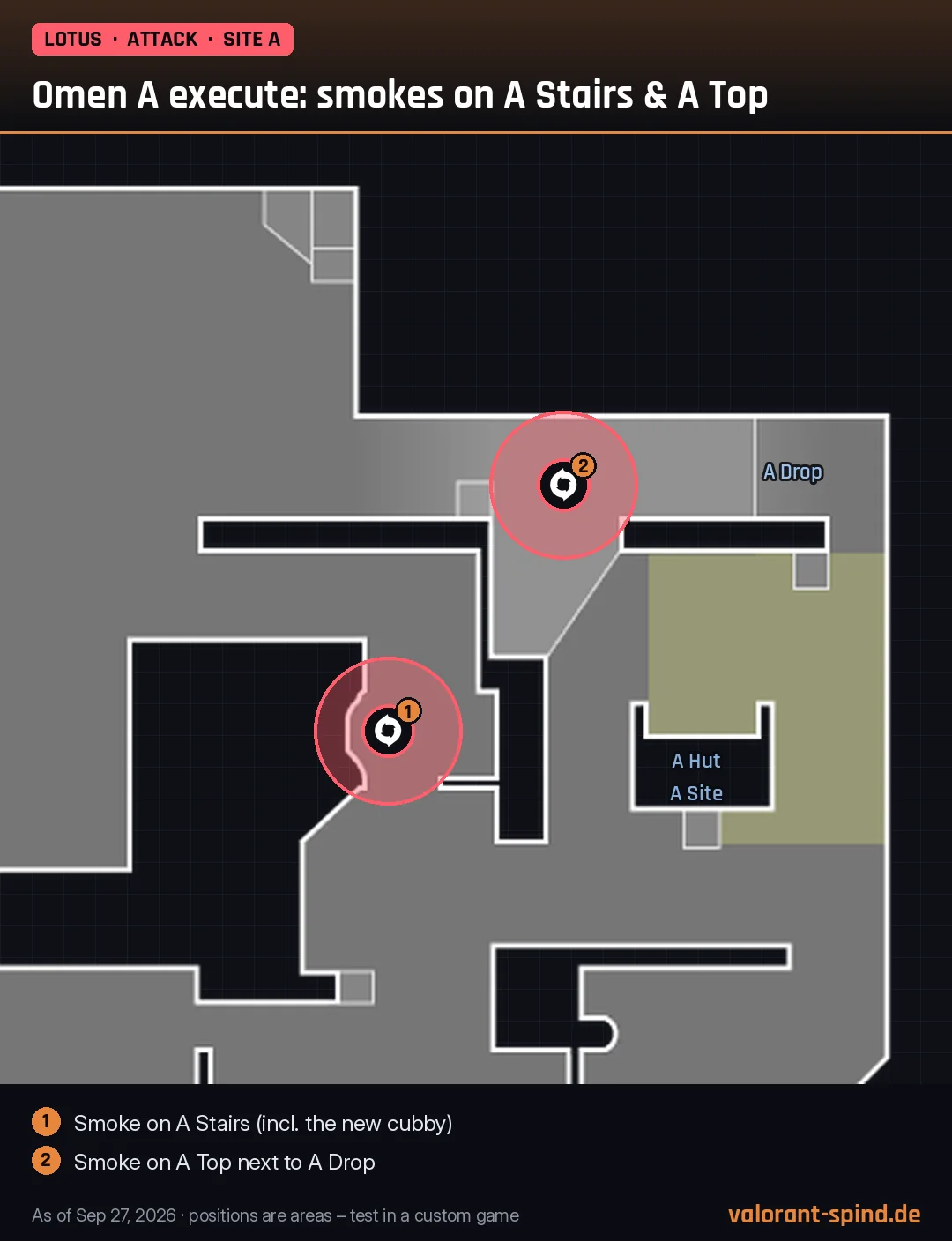
1Smoke 1: Put Dark Cover on A Stairs. It cuts off defenders on the stairs watching the path out of A Main. Since patch 12.05 there is a cubby next to the stairs – the smoke has to cover it too.
2Smoke 2: Place the second smoke on A Top, the raised area above A Drop. Nobody there can see the site.
+Tip: Then enter from A Main; one player checks Tree and the rotating door (A Door).
Covers: The two raised defender spots that watch the entrance from A Main.
Weak spot: Hut and Tree stay open. The sources predate patch 12.05 – since then the plant zone is smaller and there is a new cubby at A Stairs.
Lotus has its very own pitfalls. These five mistakes cost the most rounds in ranked:
Door at the wrong moment: a rotating door takes 10 seconds and is loud. Open it mid-fight and you give yourself away while standing still for too long.
Three sites, zero info: without info utility, defenders are just guessing. Plan at least one camera, tripwire or alarm per outer site.
Forgetting the wall: once the wall between A Main and A Link is destroyed, there’s a new route. Call it out when it’s open.
Solo retakes: whoever retakes alone dies alone. Wait for each other.
Old plant spots: since patch 12.05, plants for the breakable/Link side are no longer possible at A. Looking for the old spots wastes time.
Callout cheat sheet: what good calls sound like on Lotus
On Lotus, callouts need one extra piece of information: the state of the doors and the wall. With three sites, your team also needs to know instantly which side you’re on. These examples use only names from the official map:
“Three A Main, wall is up” – three attackers at A, the path to A Link is still closed.
“A door turning” – someone activated the rotating door between A Main and A Tree.
“C door turning, B Main” – a rotation between C Mound and B Main is happening.
“One A Drop, silent” – an enemy dropped down quietly from A Top.
“Two C Mound, going Main” – a C attack is on, two players are heading for the site.
“B empty, I’m rotating A Link” – clear info about your own rotation.
On Lotus, your own movement matters too: call it out when you rotate or use a door. Because every rotation is audible, your team can otherwise easily mistake your rotation for an enemy attack.
Lotus compared to every Valorant map
Lotus is one of the most complex maps in the game – with the most callouts of all 13 maps, three sites and several map mechanics. While Ascent, for example, works through an open mid and Split through height, Lotus is decided above all by information and fast rotations. The table shows all 13 Valorant maps compared:
With 28 callouts and three sites, Lotus needs a bit more practice. This plan helps:
5 minutes of map study: turn on “All names” above and go through A, B and C one by one using the filters.
3 minutes of quiz: play the Lotus callout quiz until you score at least 8 out of 10.
5 minutes in a custom game: activate both rotating doors, shoot down the wall at A and try the silent drop from A Top.
2 minutes of tactics: for Lotus, draw a fake on B with a rotation to A through the door on the strategy board.
Next up are the other maps in this cluster: Ascent with its doors and open mid, and Split with ropes and towers. If you want to work on your rank, our rank guide explains the whole system.
Lotus FAQ
How many callouts does Lotus have?
The official Lotus map has 28 callouts: 12 on the A side, 4 on the B side, 10 on the C side, plus attacker spawn and defender spawn.
Is Lotus in the map pool right now?
Yes. Lotus has been back in rotation since patch 12.05 (March 17, 2026) and is part of the Competitive pool since patch 13.04: Ascent, Abyss, Haven, Lotus, Split, Summit and Sunset.
How many sites does Lotus have?
Lotus has three spike sites: A, B and C. Besides Lotus, only Haven has three sites in the game.
How long does a door take to rotate on Lotus?
A rotating door turns 180 degrees in 10 seconds. Before patch 8.0 it took 8 seconds.
Where are the rotating doors on Lotus?
One is between A Main and A Tree, the other between C Mound and B Main. Both can be activated with a switch from either side.
What is the silent drop on Lotus?
If you drop from A Top to A Drop without running and land correctly, your footsteps stay silent. To get back up, use the rope from A site.
What changed on Lotus in patch 12.05?
The A side was reworked: a thicker attacker lobby wall, a moved jump up to Vines, a reinforced wall at Tree room, an extra room outside the A stairs and a changed plant zone so you can no longer plant for the breakable/Link side.
Where is Lotus set in the Valorant world?
Lotus takes place in the “City of Flowers” in the Western Ghats in the Indian state of Karnataka.
What are the best agents on Lotus?
In pro play, Omen is locked in at 100%, followed by Viper (85%), Fade (79%), Raze (65%) and Vyse (59%). The most-played pro comp is Raze, Fade, Omen, Viper, Vyse.
When was Lotus released?
Lotus released on January 10, 2023 with patch 6.0, at the start of Episode 6.
Where do you set up Vyse on Lotus?
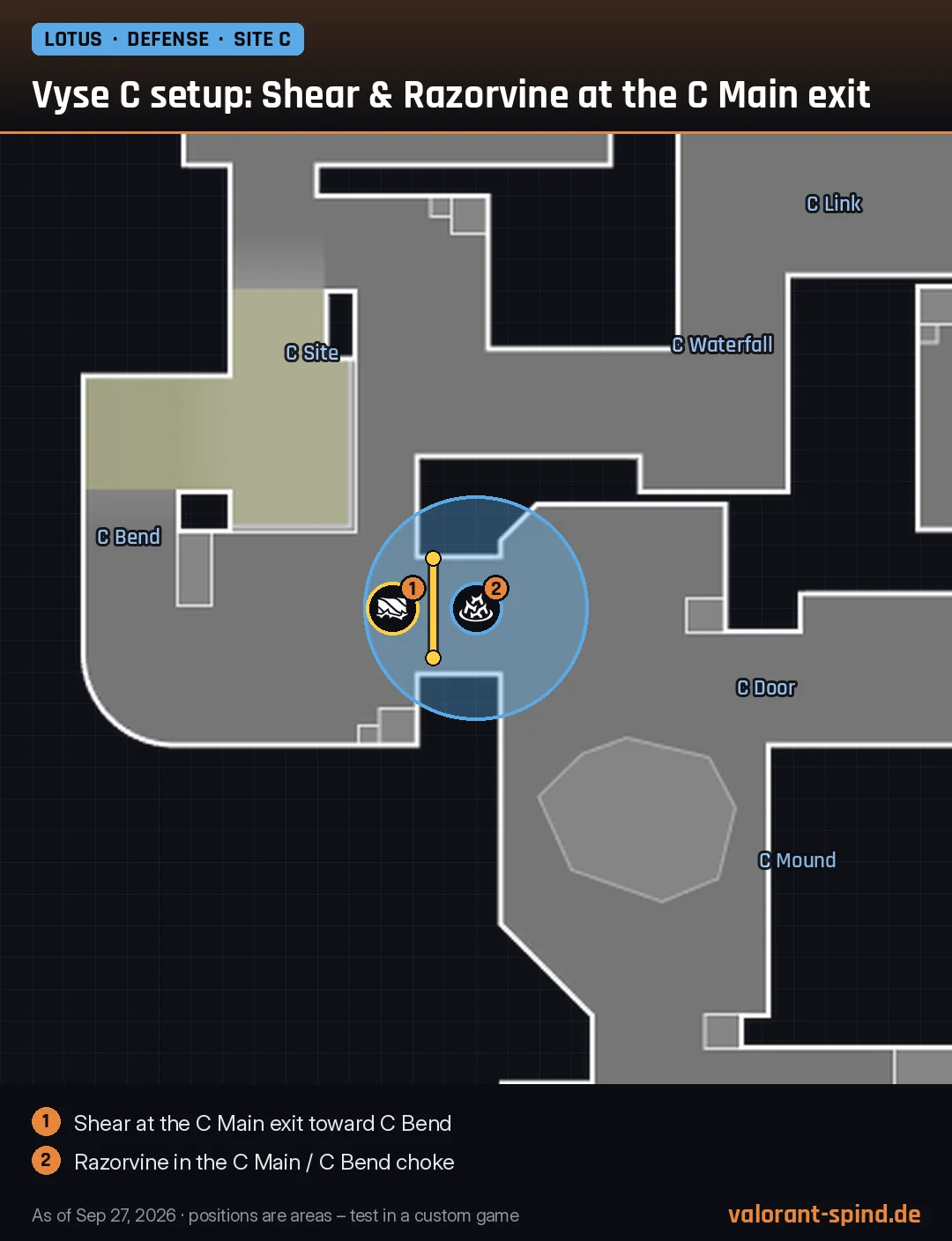
On all three sites the Shear goes into the attackers' main entrance: the passage from A Main to the site, the narrow B Main choke and the C Main exit toward C Bend. On A and C the Razorvine sits right in front of it, and on A the Arc Rose goes on the Tree wall facing A Main.
Which smokes do you need for a C execute on Lotus?
Omen smokes the two defender entrances, C Hall and C Waterfall. Then the team enters the site through C Main and C Bend.




 Vyse
Vyse Shear: Place the Shear across the passage attackers use to walk from A Main onto the site. Whoever crosses it triggers the wall behind them and faces you alone.
 Razorvine: Throw the Razorvine right in front of it in A Main. Activate it as attackers approach the Shear – they are slowed and take damage.
 Arc Rose: Put the Arc Rose in Tree on the wall that borders A Main – it can be placed through the wall. Activate it as soon as enemies stand in A Main.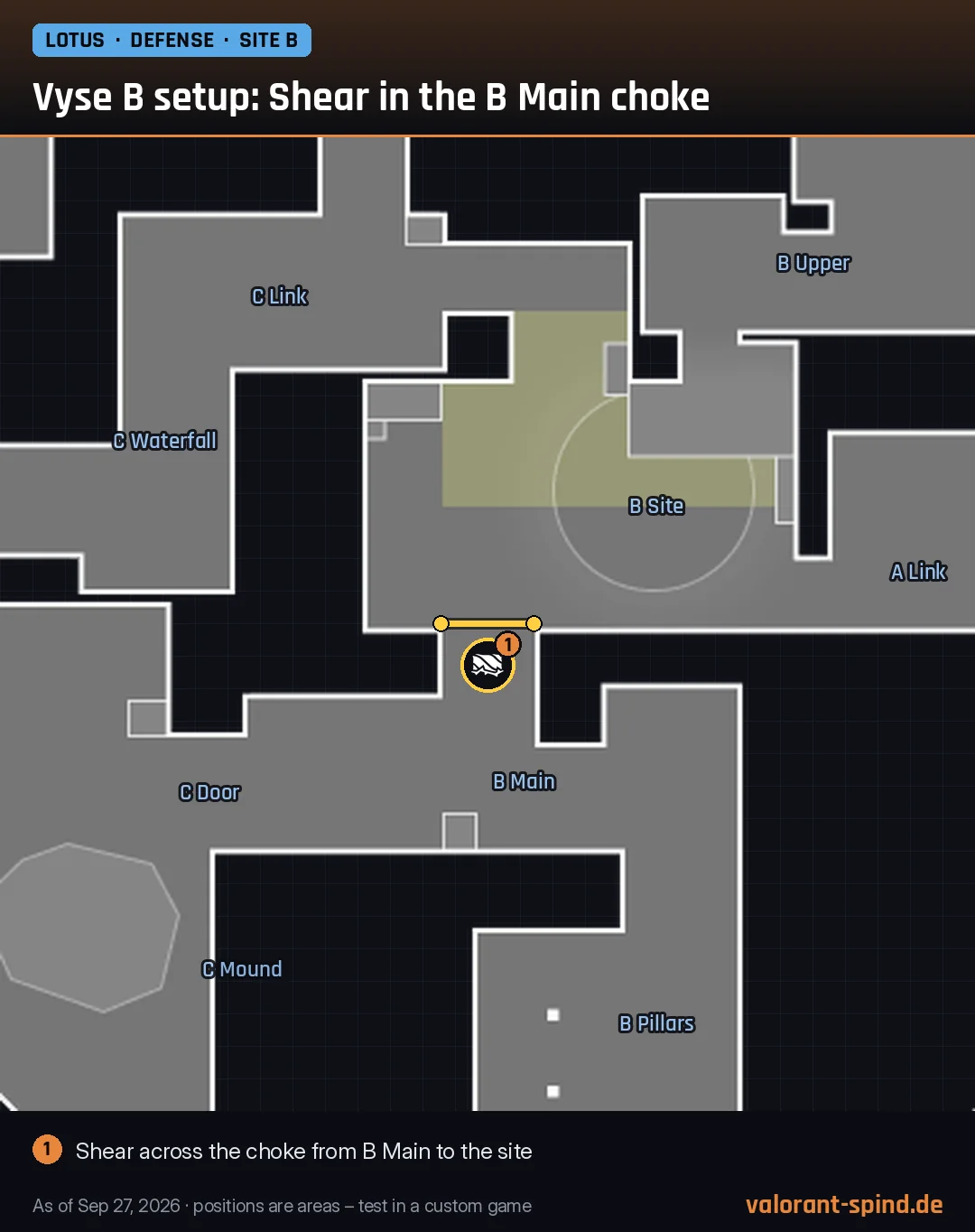
 Omen
Omen