All 22 callouts on the official map, ziplines, automatic door and rope explained, the current pool status, the pro meta with real numbers and tips for pincer attacks and defending from the middle – plus a callout quiz.
New to Valorant? The app has your backLocker value in VP & euros and a coach with heatmaps – ideal alongside “Fracture guide”, 100% local, no login, free.
The official Fracture minimap from the Valorant API shows all 22 callouts in their real position. Tap your way around the map or test yourself in the callout quiz – so the names stick before your next match.
1Tap a dot or a name – the map shows the area and nearby callouts.
2Use the filters and “All names” to learn one area at a time.
3“Start quiz”: 10 random callouts, you tap the right spot.
What the map does for you
You make precise callouts in matches instead of “one back there”.
You understand where rotations run and which areas connect.
The quiz trains fast recall – exactly what counts in a match.
All positions come from the official map – no made-up names.
Tip: combine “All names” with a filter for one side to learn Fracture fastest – start with the side you play most, then the rest.
⚡ Quick answer
Fracture is a Valorant map with two spike sites (A and B), set in a secret Kingdom research facility in New Mexico that was split apart by a failed radianite experiment. The official map has 22 callouts. Its defining feature is the unusual layout: defender spawn sits in the middle, while attackers start in one spawn and reach the other side of the map via two one-way ziplines under defender spawn. Fracture has not been in the Competitive pool since patch 13.00 (June 23, 2026), but you can still play it in custom games. In pro play, Brimstone was by far the most-picked controller at 86%.
How to use the interactive Fracture map
Above you see the official Fracture minimap straight from the Valorant API – with all 22 callouts exactly where the game itself places them. Tap a dot or a name in the list and the map highlights the callout, shows its area and its three nearest neighboring callouts. Use the filters to show only A, B or the spawn areas. Fracture has no classic mid – the center of the map belongs to the defenders.
Turn on “All names” and Fracture’s special pattern jumps right out at you: Defender Spawn sits exactly in the center of the map, B Site is on the left edge and A Site on the right. Attacker Spawn is at the bottom center, and at the very top center you’ll find Attacker Bridge – the second attacker side, which attackers reach via the ziplines. Once you’ve internalized that picture, Fracture makes sense instantly: attackers can hit every site from two sides, while defenders stand in the middle and have to think in two directions.
If you think you know Fracture, start the callout quiz: ten random callouts, you tap the right spot, and at the end you see your hit rate. On Fracture that’s especially valuable, because many names exist at both A and B – Link, Main, Site – and because “Bridge” and “Spawn” refer to two completely different attacker areas. For all 13 maps and several difficulty levels, try the full callout trainer.
Fracture at a glance
Official Fracture splash artwork (source: Valorant API)
Property
Value
Release
September 8, 2021 · patch 3.05 (Episode 3, Act 2)
Setting
Everett-Linde Research Facility, Santa Fe County, New Mexico (USA)
Spike sites
2 (A and B)
Callouts
22 (official map)
Special feature
Defender spawn in the middle, 2 one-way ziplines under defender spawn, automatic door in A Hall, 4 ultimate orbs
In the pool
No – out of the pool since patch 13.00 (June 23, 2026)
Fracture arrived on September 8, 2021 with patch 3.05, during Episode 3, Act 2. According to the Valorant Wiki, its internal codename was “Canyon.” Riot officially describes the map as a top secret research facility split apart by a failed radianite experiment: with defender options as divided as the map, the choice is yours – meet the attackers on their own turf or batten down the hatches to weather the assault. Those two basic stances still shape every defender round on Fracture today.
According to the Valorant Wiki, the setting is the Everett-Linde Research Facility in Santa Fe County, New Mexico, USA. The lore wiki explains that the facility was a collaboration between the Kingdom organizations of Alpha Earth and Omega Earth, where a Radian Collider was developed for the study of radianite particles. In an incident that the lore wiki says was orchestrated by α-Chamber and Ω-Chamber, the collider exploded. The result was the “Dual-Biome Split”: a massive blue fracture separates the two halves of the facility – and it’s this fracture that gives the map its name. Three trivia items from the wiki round out the picture: the Radian Collider occasionally pulses with sound effects, Fracture was the first map to get its own lore updates with each patch, and the design that lets defenders pinch attackers took some inspiration from the Battle of Helm’s Deep in “The Two Towers.”
Fracture mechanics: ziplines, automatic door and rope
Fracture has more layout quirks than almost any other map. All information in this section comes from the official Valorant Wiki.
The layout: four quadrants and a defender core
The wiki describes the layout like this: Fracture splits the map into four neutral quadrants, plus four central areas between the quadrants that contain the sites and the attacker sides, and a central zone where defenders spawn. On the minimap that means: B on the left, A on the right, attackers at the bottom and top, defenders in the middle. That creates the typical shape many players describe as an “H.”
One attacker spawn, two attack sides
A common misconception: on Fracture, attackers do not spawn on both sides. The wiki is clear here – all attackers spawn in one area, but they can reach the other side using the cross-map ziplines that run underneath defender spawn. On the official map, that other side is Attacker Bridge at the top edge. The result is still unique: attackers can hit any site from two sides at once, but they have to decide before the round who takes the zipline.
The two one-way ziplines
Underneath defender spawn run two parallel one-way ziplines, one going south to north and one going north to south. They work differently from the ropes on other maps. As soon as you attach, you automatically travel at full speed to the other end. According to the wiki, while riding you can’t change direction, use abilities, detach or stop. The only thing you can do: hold Shift to slow yourself down.
An important special rule concerns the spike: if the spike carrier drops the spike or gets killed on the zipline, the wiki says the spike will respawn on the closer side of the zipline. So the spike isn’t lost, but it may end up on the side where your team doesn’t need it right now. Plan who carries the spike before you split up.
The automatic door in A Hall
A Hall contains an automatic door that works similarly to the exit doors of Bind’s teleporters. It opens instantly once a player gets close enough, makes a loud audio cue as it does, and also opens for any objects thrown toward it. Unlike on Bind, it reacts to players from both sides. On the official map, the A Door callout sits right next to A Hall. Tactically, that means the door gives away movement. Anyone rotating through A Hall unintentionally tells the enemy where they are.
The rope at A Rope
Besides the ziplines, Fracture also has a classic rope (ascender). The wiki places it at A Rope – the callout name already gives it away. On the map, A Rope sits between A Door and A Link and is one of the callouts closest to Attacker Spawn. Patch 5.07 redesigned A Rope, according to Riot to give defenders the freedom to adopt new strategies.
Four ultimate orbs
According to the wiki, each quadrant contains one ultimate orb. That gives Fracture four orbs instead of the usual two. Because the quadrants are neutral areas between attackers and defenders, it pays to grab orbs deliberately when the round allows it – two extra orbs mean faster ultimates on Fracture.
Fracture rule of thumb: one spawn, two sides, one-way street. On the zipline there’s no turning back and no abilities – if you take it, you need to know why. And everyone hears the door in A Hall.
All 22 Fracture callouts explained
The table lists every Fracture callout from the official map with its area and the three spatially closest callouts. The breakdown: 10 callouts on the B side, 9 on the A side, 2 on the attacker side (Attacker Spawn and Attacker Bridge), plus Defender Spawn. Fracture has no mid with its own callouts. The table uses the names from the English client. In the German client, only the spawn areas are translated – Attacker Bridge becomes “Angreifer Bridge,” for example – while all other names are identical, so the callouts work with German-speaking teammates too.
Callout
Area
Nearby
A Dish
A side
A Gate, A Drop, A Link
A Door
A side
A Hall, A Rope, A Main
A Drop
A side
A Site, A Link, A Dish
A Gate
A side
A Dish, Attacker Bridge, A Drop
A Hall
A side
A Door, A Main, A Rope
A Link
A side
A Drop, A Rope, Defender Spawn
A Main
A side
A Door, A Hall, A Site
A Rope
A side
A Door, A Hall, A Link
A Site
A side
A Drop, A Link, A Main
B Arcade
B side
B Link, B Tower, B Bench
B Bench
B side
B Arcade, B Link, Attacker Bridge
B Canteen
B side
B Tunnel, B Generator, B Link
B Generator
B side
B Link, B Tunnel, B Canteen
B Link
B side
B Generator, B Arcade, Defender Spawn
B Main
B side
B Tree, B Tunnel, B Site
B Site
B side
B Tower, B Tunnel, B Main
B Tower
B side
B Site, B Arcade, B Tunnel
B Tree
B side
B Main, B Canteen, B Tunnel
B Tunnel
B side
B Canteen, B Generator, B Main
Attacker Bridge
Attacker spawn
A Gate, B Bench, A Dish
Attacker Spawn
Attacker spawn
A Rope, A Hall, B Tree
Defender Spawn
Defender spawn
A Link, B Link, B Generator
The spawns: Attacker Spawn, Attacker Bridge and Defender Spawn
Attacker Spawn sits at the bottom center of the map. Its nearest callouts are A Rope, A Hall and B Tree – so from here you can reach both sites. Attacker Bridge mirrors it at the very top center; its nearest callouts are A Gate, B Bench and A Dish. Defender Spawn sits in the center, right between A Link and B Link, with B Generator close by as well. That position explains the defenders’ special strength on Fracture: both sites are within reach from the middle without ever having to cross the entire map.
B side, south: Tree, Main, Tunnel and Canteen
In the bottom-left quarter of the map lie B Tree and B Main. B Tree borders Attacker Spawn, while B Main sits further left and already borders B site. Above them are B Tunnel and B Canteen, which sit close together. According to the wiki, patch 3.06 made the tunnel between Generator and Canteen impenetrable – an early safeguard against wallbangs in this tight area.
B side, north: Bench, Arcade and Tower
From Attacker Bridge, B Bench is the nearest B callout. Below and to the left of it is B Arcade, and further left B Tower, which sits directly above B site. With patch 5.07 (October 4, 2022), Riot opened up a small cubby in B Arcade to make it easier for attackers to hold the area and counter multi-directional aggression.
B side, site and defenders: Site, Generator and Link
B Site sits on the left edge of the map, between B Tower above and B Main below. To its right, toward Defender Spawn, are B Generator and B Link. Patch 5.07 tightened things up here too: the choke at B Generator was narrowed so smokes cover it better, and a corner was removed; on B site, a new ramp replaced a former jump. Patch 3.06 also made one crate on B site impenetrable.
A side, south: Hall, Door, Main and Rope
In the bottom-right quarter, A Hall and A Door sit close together, with A Main to their right, bordering A site. Up and to the left of A Door is A Rope with the rope. The automatic door is in A Hall. With patch 5.07, Riot removed a cubby in A Hall to simplify the space and make moving around easier.
A side, north: Gate, Dish and Drop
From Attacker Bridge, A Gate is the nearest A callout. Below it is A Dish, and further down to the right A Drop, directly above A Site. This area was also reworked in patch 5.07: a far path at A Dish was cut out, leaving a single, direct approach, and A Drop was extended and given a new cubby.
A side, site and defenders: Site and Link
A Site sits on the right edge of the map, between A Drop above and A Main below. A Link connects the A side with Defender Spawn and borders A Drop and A Rope. Whoever holds A Link can switch quickly between site and spawn as a defender – and as an attacker can cut off the defenders’ rotation from here.
Is Fracture in the map pool? Rotation history
No. Fracture has been out of the Competitive rotation since patch 13.00 (June 23, 2026). The official patch notes put it this way: Summit and Sunset are in the Competitive and Deathmatch queues, Fracture and Pearl are out. The pool used for Competitive since patch 13.04 (August 18, 2026) doesn’t include Fracture either: it consists of Ascent, Abyss, Haven, Lotus, Split, Summit and Sunset. You can reliably still play Fracture in a custom game.
The rotation history in brief, backed by the official patch notes: with patch 7.04 (August 29, 2023), Fracture was rotated out of the Competitive and Unrated rotation together with Pearl. With patch 10.00 in January 2025, Fracture came back together with Lotus. With patch 10.08 (April 29, 2025), Fracture left again as Sunset returned. With patch 12.05 (March 17, 2026), Fracture returned to the pool together with Lotus once more – and stayed for only a little over three months until patch 13.00. Since patch 10.00, Riot has said maps rotate every act, so a return is always possible, but none has been announced. You’ll always find the current status of every map on our Valorant maps & map pool overview.
The biggest rework happened a while ago: with patch 5.07 (October 4, 2022), Riot simplified the map in many places – a new cubby in B Arcade, a ramp instead of a jump on B, a narrower choke at B Generator, a removed cubby in defender spawn to simplify retakes, a removed cubby in A Hall, a cut far path at A Dish, an extended A Drop and a redesigned A Rope. Shortly after release, patch 3.09 had already moved an ultimate orb in A Hall into neutral space and added cover against a sightline into attacker spawn, among other things. Later updates were mostly bug fixes around the ziplines, such as patch 9.07 fixing a trick that let Deadlock float on the ziplines with Barrier Mesh.
Fracture pro meta: who gets picked
Valorant-Spind doesn’t have a dedicated presence table for Fracture like it does for the maps in the current pool. Instead, we analyzed the team comps played during the phase when Fracture was in the VCT pool in 2026: VCT 2026 Stage 1 across four regions plus Masters Santiago and Masters London 2026, 36 team comps in total, sourced from vlr.gg. You’ll find current pick rates for the maps in the pool in our pick rate overview.
Fracture: Top 5 by pick rate (36 team comps) · source: vlr.gg, VCT 2026 Stage 1 (4 regions) + Masters Santiago/London 2026
The top 5 by pick rate on Fracture are Neon, Raze, Fade, Brimstone, Cypher (Top 5 by pick rate (36 team comps) · vlr.gg: VCT 2026 Stage 1 (4 regions) + Masters Santiago/London 2026). Important: this isn’t a single comp that was played as-is, but the five most frequently picked agents. Brimstone at 86% stands out. His Sky Smoke places smokes from a distance, which makes it ideal for pincer attacks from two sides, where a team has to close sightlines on the north and south of a site at the same time. Fade scouts the many angles with Haunt and Prowler, Cypher holds the flank with Trapwire and Spycam, and Neon and Raze provide fast entries. Raze and Breach tie for fifth place. Test your own ideas in the team comp builder.
What stands out: only a single controller appears in the top 5. That doesn’t mean pros never played Fracture with two smokers – but every other controller’s pick rate fell outside the top 5. The rest of the most-picked agents split between tempo (Neon, Raze) and information (Fade, Breach). For your own ranked comp that’s a useful compass: one reliable controller, one or two info agents, a fast entry and a sentinel for the flank.
Attacking on Fracture: tips for the attacker side
As an attacker on Fracture, you have a weapon no other map offers: the second attack side via the ziplines. Use it wisely and you force the defenders to hold two directions at once.
Set the split before the round: decide during the buy phase who takes the zipline to Attacker Bridge. On the zipline you can’t turn around or use abilities – spontaneous switches cost time.
Pincer with timing: an attack on a site from both directions – on B via B Main and B Tower, or on A via A Main and A Drop, for example – is only strong if both groups arrive at the same time. If one side is late, you’re fighting two separate duels.
Pick the spike carrier deliberately: if the spike carrier dies on the zipline, the spike respawns on the closer side. Give the spike to the group that needs it for the planned plant.
Cut off the links: A Link and B Link connect the sites to Defender Spawn. Smokes or pressure on the link of the site you’re hitting stops defenders trying to rotate from the middle.
Grab the orbs: with four ultimate orbs, Fracture has twice as many as most maps. Collect them in quiet moments and your ultimate comes online sooner.
A common mistake in ranked is taking the zipline too late. Switch sides mid-round and you waste time and ride without abilities onto a side the defenders may already be watching. Better: split early, gather information on both sides and then strike together. Plan these plays beforehand on the strategy board.
A five-player hit from one side can work on Fracture too – especially when the defenders expect you to split up. Use the noise of the door in A Hall as a distraction: trigger it deliberately on the south side to draw the A defenders’ attention there while the real attack happens elsewhere.
Defending on Fracture: tips for the defender side
Riot itself describes the defenders’ choice on Fracture: meet the attackers on their own turf or batten down the hatches. Both work – what matters is that the whole team is running the same plan.
Use the center: Defender Spawn sits between A Link and B Link. Both sites are within quick reach from there – your rotations are shorter than those of attackers who have to take the zipline.
Information on both sides: every site can be hit from the north and the south. A Trapwire, a Spycam or an Alarmbot on one of the two sides tells you whether a pincer is coming.
Aggressive, but coordinated: meeting the attackers “on their own turf” can disrupt a planned attack early. But it only works if the other defenders know a player is up front.
The A Hall door as an alarm: when the automatic door opens, you hear it. Use it as a natural early-warning system for movement in the south of A.
Retake through the link: if a site falls, come out of the middle via A Link or B Link into the attackers’ backs. Group up first – solo retakes against a post-plant position almost always fail.
Watch for the pincer: on Fracture, an attack on one site can come from two directions at once. Focus on only one entrance and you’ll get hit in the back. Spread your attention – and your utility – across both sides of the site.
In ranked, it pays to listen closely: the zipline ride is a one-way street without abilities. If you see or hear attackers switching to the other side, you know they can neither fight nor throw utility during that time. That’s exactly the moment to quickly adjust your defense.
Fracture setups: Cypher & Brimstone smokes
Here are the key Fracture setups to copy – no video needed: every position is marked on the official minimap, numbered and explained step by step. The agents come from the Fracture pro comp in VCT 2026: Brimstone (in 86% of recorded comps) for the executes and Cypher as the sentinel.
Every setup is backed by at least two matching sources – anything with only one source was left out. Important: the markers show the area, not the exact pixel. Try each setup once in a custom game before you use it in ranked.
Geometry unchanged since patch 5.07 (Oct 2022), only bug fixes since; older sources on the areas reworked back then (A Drop, A Rope, B Arcade, B Generator) were not counted. Agents from the Fracture pro comp (vlr.gg, 2026): Brimstone in 86% of comps, Cypher in the top 5.
Cypher A setup: trips & one-way cages at A Main and A Door
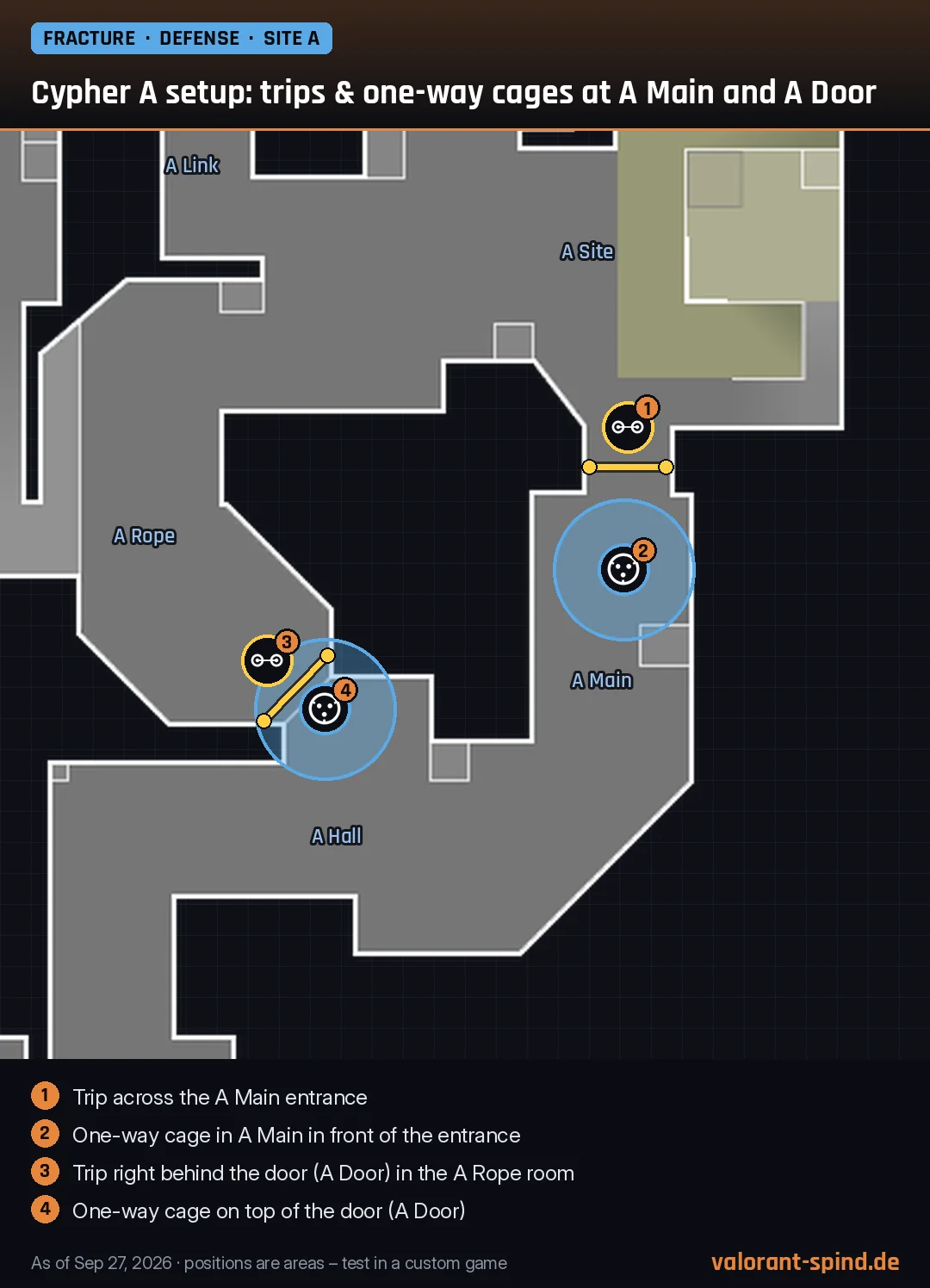
1Trip 1: Stretch the wire on the site side across the narrow A Main entrance – attackers walk into it as soon as they step from A Main onto the site.
2Cage 1: Stand at the A Main entrance and throw the Cyber Cage onto the small ledge above it. As a one-way you see the attackers' feet while they can't see you.
3Trip 2: Put the second wire in the A Rope room right behind the automatic door (A Door) that leads in from A Hall.
4Cage 2: Stand in the corner by A Rope, hug the metal wall and throw the cage onto the top of the door frame. That creates a second one-way.
+Tip: The door opens loudly – anyone coming through A Hall announces themselves as well.
Covers: Both attacker routes from below: A Main and the door from A Hall to A Rope.
Weak spot: A Drop (the route from Attacker Bridge above) is not covered – you need a teammate or your Spycam there. The one-ways only work at the exact height: test them in a custom game.
1Cage 1: Stand in the corner on B site and aim at the small line on the site wall – the cage lands at the top of the B Main exit. Play it from B Tower, where you can see the attackers' feet.
2Cage 2: Throw the second cage onto the ledge at the B Arcade exit, where the path to B Tower branches off. That lets you stall the Arcade push from inside the smoke.
+Tip: Adjust trapwires and Spycam to your opponents – for fixed spots on the current layout we found no two matching sources.
Covers: The two attacker routes onto B: B Main (from below) and B Arcade (from Attacker Bridge).
Weak spot: Without trips you get no info while the cage isn't active. One-ways lose value quickly against flashes and mollies.
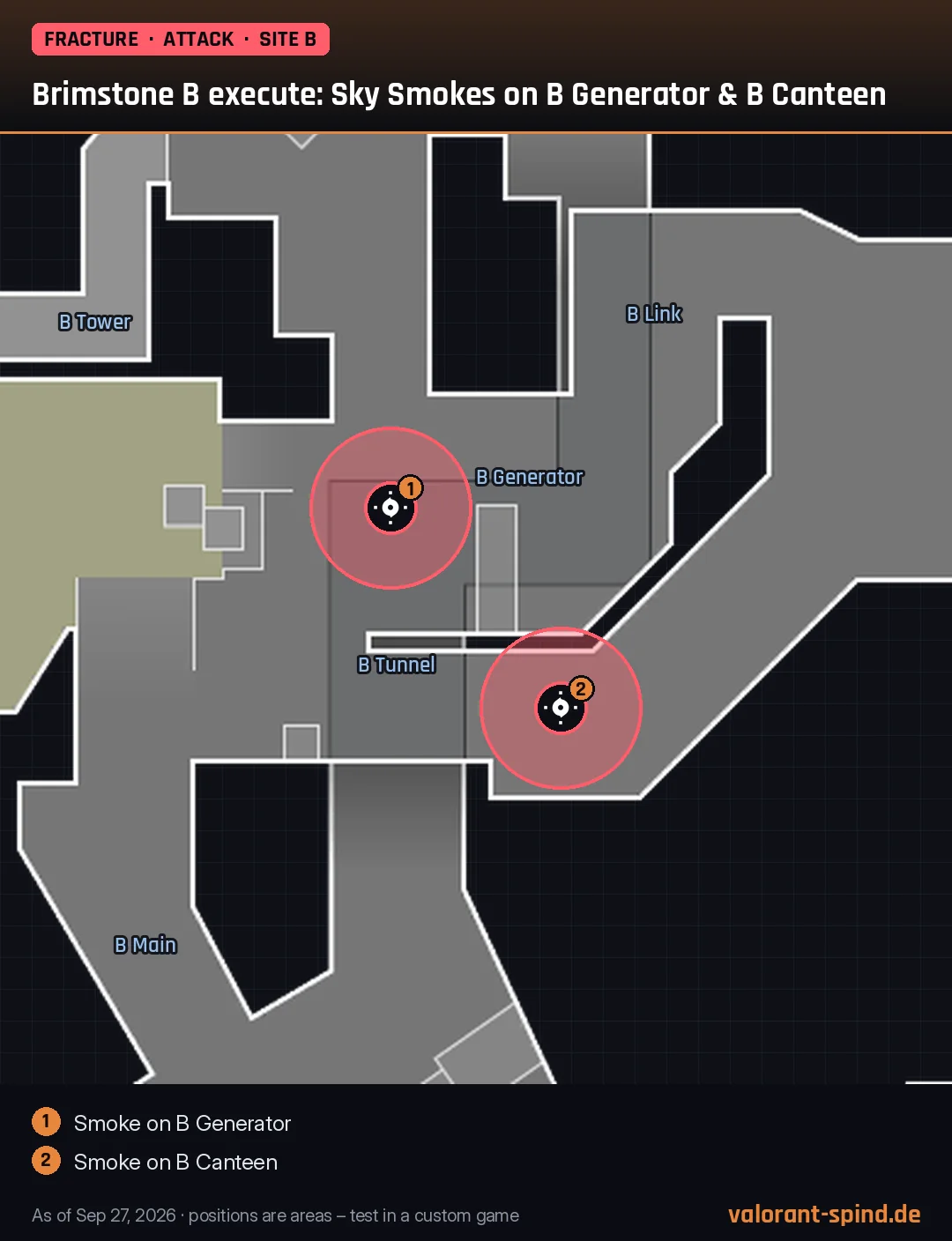
1Smoke 1: Place the first Sky Smoke on B Generator to the right of the site. Defenders come out of B Link here and would otherwise have a clear view of the site.
2Smoke 2: Put the second smoke on B Canteen – it blocks the second rotation path from Defender Spawn.
+Tip: Then go up the stairs from B Main onto the site. If part of the team comes through B Arcade, clear or smoke B Tower first.
Covers: Both defender rotation paths from the middle: B Generator and B Canteen.
Weak spot: B Tower (raised above the site) stays open and has to be cleared – use the third smoke or a flash for it.
You don’t need to copy a pro comp for ranked, but you should cover the roles. This selection is based on the top 5 pick rates from VCT 2026 Stage 1 and the Masters events, plus the map’s layout:
Trapwire and Spycam lock down the flank – especially valuable on a map with attacks from two directions.
The agent test shows which agent suits your playstyle on Fracture. You’ll find the current overall ranking of every agent in the agent tier list.
The 5 most common mistakes on Fracture
Fracture has its very own traps. These five mistakes cost the most rounds in ranked:
Zipline without a plan: on the zipline you can’t turn around, stop or use abilities. Switch sides on a whim and you lose time and control.
Spike on the wrong side: if the spike carrier dies on the zipline, the spike respawns on the closer side. That can wreck the whole plan.
Holding only one direction: as a defender, watching only one entrance is deadly on Fracture. Every site can be hit from two sides.
Forgetting the door: the automatic door in A Hall opens loudly. If you want to rotate unnoticed, pick another route.
Mixing up Bridge and Spawn: Attacker Bridge is at the top, Attacker Spawn at the bottom. Swap them and you send the rotation to the wrong side of the map.
Callout cheat sheet: what good calls sound like on Fracture
On Fracture, every callout needs one extra piece of information: which side the enemy is coming from. Because attackers can reach every site from the north and the south, that info decides every rotation. These examples use only names from the official map:
“Two B Main, one B Tower – pincer B” – B is being hit from below and above at the same time.
“Three on the zipline toward Bridge” – a large part of the attackers is switching to the north side.
“A Hall door opened” – someone is moving in the south of the A side.
“One A Dish, going Drop” – an attacker is coming onto A from above.
“B Link clear, I’m rotating B” – clear info about your own rotation from the middle.
“Spike is at A Rope” – the exact position of the spike after a kill.
The most important rule on Fracture: direction before location. “One A” isn’t enough – “one A Gate” or “one A Main” instantly tells your team whether the pressure is coming from above or below. Just as important is calling your own zipline ride, so your team knows which side you’re about to show up on.
Fracture compared to the other maps
Fracture has the most unusual layout in the entire game. While attackers and defenders start at opposite ends on almost every other map, here the defenders spawn in the middle, and attackers reach a second attack side via one-way ziplines. Icebox uses ziplines horizontally at one site, Split and Lotus use ropes, Bind has teleporters – but only Fracture builds the whole map around the idea of hitting every site from two sides. On top of that come four ultimate orbs instead of two. The table shows all 13 maps at a glance:
Want to get comfortable on Fracture fast – for custom games with friends or for its next return to the pool? This small training plan combines the tools on Valorant-Spind:
5 minutes of map study: turn on “All names” above and memorize the three spawn areas first, then the north and south sides of A and B.
3 minutes of quiz: play the Fracture callout quiz until you score at least 8 out of 10.
5 minutes in a custom game: ride both ziplines once, try slowing down with Shift, walk through the automatic door in A Hall and climb the rope at A Rope.
2 minutes of tactics: for Fracture, draw a pincer on B on the strategy board – two players via Bridge, three via B Main.
After that, take a look at two related maps: Icebox, the first map with horizontal ziplines, and Bind, whose teleporter exit doors work similarly to the automatic door in A Hall. And if you want to test your team lineup, the team comp builder is the right tool.
Fracture FAQ
How many callouts does Fracture have?
The official Fracture map has 22 callouts: 10 on the B side, 9 on the A side, 2 on the attacker side (Attacker Spawn and Attacker Bridge), plus Defender Spawn.
Is Fracture in the map pool right now?
No. Fracture has not been in the Competitive pool since patch 13.00 (June 23, 2026). The pool since patch 13.04 consists of Ascent, Abyss, Haven, Lotus, Split, Summit and Sunset. You can still play Fracture in custom games.
Do attackers spawn on both sides on Fracture?
No. According to the Valorant Wiki, all attackers spawn in one area. Using two one-way ziplines under defender spawn, they can reach the other side of the map, which is called Attacker Bridge on the map.
How do the ziplines work on Fracture?
There are two parallel one-way ziplines under defender spawn. As soon as you attach, you automatically travel at full speed. You can’t turn around, stop, detach or use abilities, but you can slow down by holding Shift.
What happens to the spike on the zipline?
If the spike carrier drops the spike or gets killed on the zipline, the Valorant Wiki says the spike respawns on the closer side of the zipline.
Where is the automatic door on Fracture?
The automatic door is in A Hall. It opens instantly when a player gets close enough, also opens for thrown objects, and makes a loud sound as it does.
How many ultimate orbs does Fracture have?
Fracture has four ultimate orbs, one in each of its four quadrants. Most other maps have only two.
When was Fracture released?
Fracture released on September 8, 2021 with patch 3.05 during Episode 3, Act 2.
What are the best agents on Fracture?
The top 5 by pick rate from VCT 2026 Stage 1 and Masters Santiago/London 2026 are Neon, Raze, Fade, Brimstone and Cypher. Brimstone led clearly at 86%, and Breach ties Raze for fifth.
Where is Fracture set in the Valorant world?
Fracture takes place at the Everett-Linde Research Facility in Santa Fe County, New Mexico, USA. An exploded Radian Collider tore the facility into two halves, which is where the name comes from.
Where do you set up Cypher on Fracture A?
One Trapwire goes across the A Main entrance, the second right behind the door (A Door) in the A Rope room. Add a one-way Cyber Cage in front of A Main and one on top of the door frame.
Which smokes does Brimstone need for a B execute on Fracture?
Brimstone smokes B Generator and B Canteen, the two rotation paths from Defender Spawn. Then the team enters the site through B Main; B Tower still has to be cleared.



 Cypher
 Trip 1: Stretch the wire on the site side across the narrow A Main entrance – attackers walk into it as soon as they step from A Main onto the site.
 Cage 1: Stand at the A Main entrance and throw the Cyber Cage onto the small ledge above it. As a one-way you see the attackers' feet while they can't see you.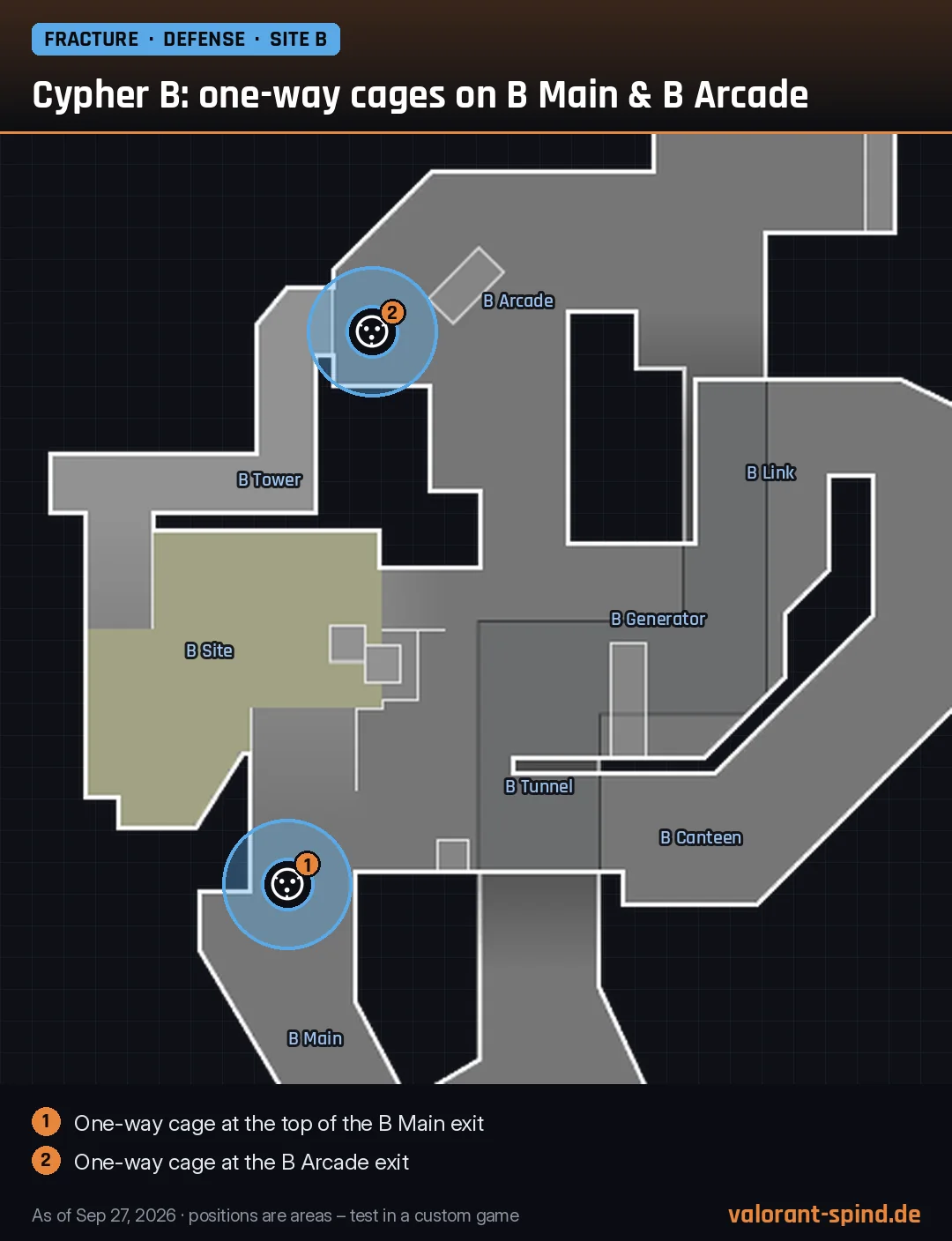
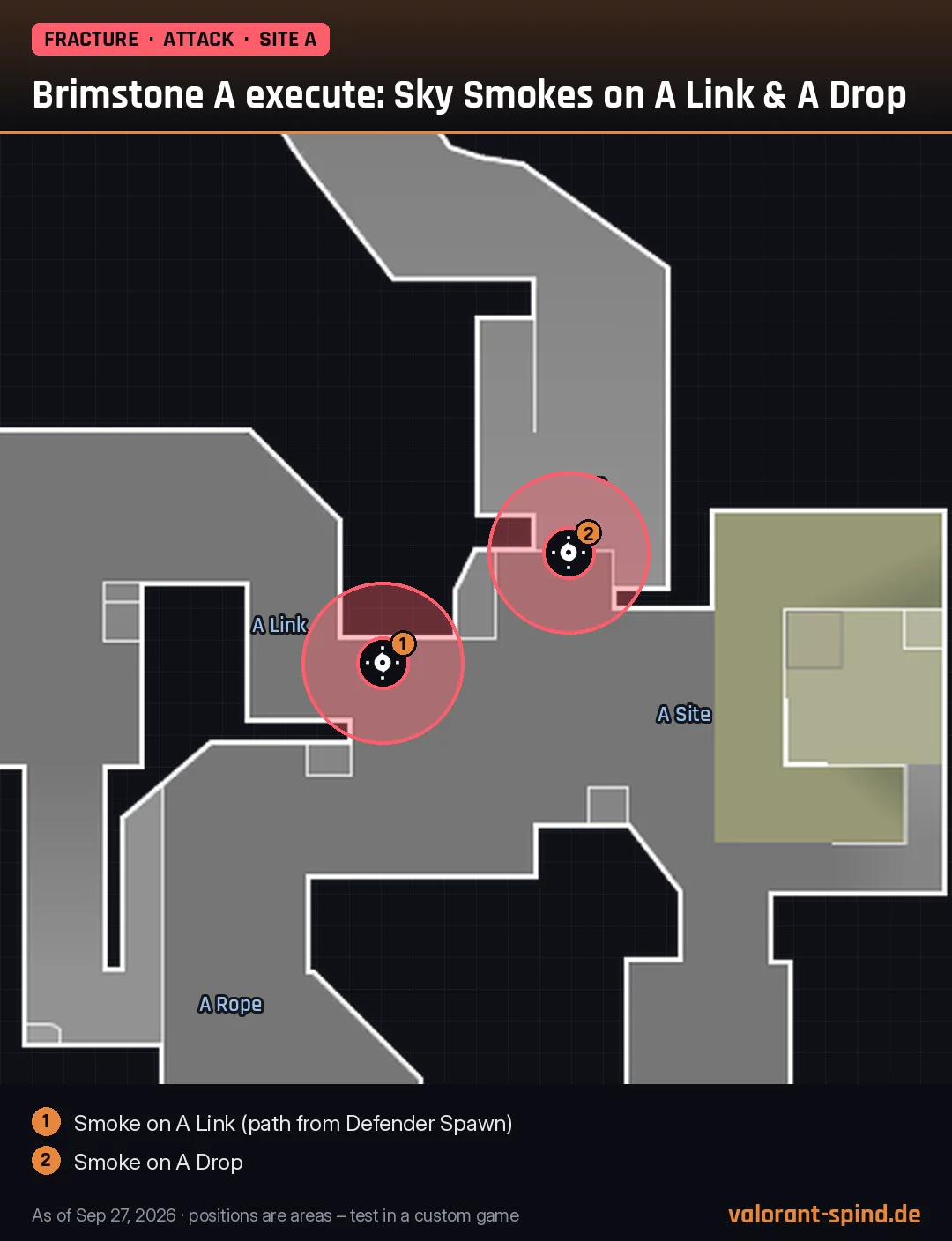
 Brimstone