All 24 callouts on the official map, the two one-way teleporters explained, the pro comp with real numbers and concrete attack and defense tips – plus a callout quiz to learn Bind in minutes.
The official Bind minimap from the Valorant API shows all 24 callouts in their real position. Tap your way around the map or test yourself in the callout quiz – so the names stick before your next match.
1Tap a dot or a name – the map shows the area and nearby callouts.
2Use the filters and “All names” to learn one area at a time.
3“Start quiz”: 10 random callouts, you tap the right spot.
What the map does for you
You make precise callouts in matches instead of “one back there”.
You understand where rotations run and which areas connect.
The quiz trains fast recall – exactly what counts in a match.
All positions come from the official map – no made-up names.
Tip: combine “All names” with a filter for one side to learn Bind fastest – start with the side you play most, then the rest.
⚡ Quick answer
Bind is a Valorant map with two spike sites (A and B) and no mid, set at a radianite refinery in Rabat, Morocco. The official map has 24 callouts. Instead of a mid, two one-way teleporters connect the sites: one from A Short to B Short and one from B Long to A Lobby – and every player on the map hears each teleport. Bind has been out of the Competitive pool since patch 12.08 (April 28, 2026), but you can still play it in a custom game. The most-played pro comp runs Viper and Brimstone as a double controller setup.
How to use the interactive Bind map
Above you see the official Bind minimap straight from the Valorant API – with all 24 callouts exactly where the game itself places them. Tap a dot or a name in the list and the map shows you the callout, its area and the three nearest neighboring callouts. Use the filters to show only the A side, only the B side or the spawns. You won’t need a mid filter on Bind: according to its official description, the map simply has no mid. “All names” labels the entire map at once – especially useful on Bind, because you instantly see where both teleporter entrances and their exits are.
If you think you know Bind in your sleep, start the callout quiz: ten random callouts, you tap the right spot, and at the end you see your hit rate. On Bind that’s well worth it, because names like A Lamps, A Cubby, B Elbow and B Fountain sit close together and get mixed up in the heat of a fight. If you can recall every name instantly, you win the decisive second in a match. For all 13 maps and several difficulty levels, try the full callout trainer.
Bind at a glance
Official Bind splash artwork (source: Valorant API)
Property
Value
Release
Closed beta from April 7, 2020 · one of the first three standard maps
Setting
Rabat, Morocco – a Kingdom Corporation radianite refinery
Spike sites
2 (A and B)
Mid
None – per the official description
Callouts
24 (official map)
Special feature
2 one-way teleporters (A Short → B Short, B Long → A Lobby), every teleport audible to all players
In the pool
No – out of the pool since patch 12.08 (April 28, 2026)
Bind is one of Valorant’s first three standard maps: it was already playable in the closed beta that started on April 7, 2020 – together with Haven and Split, and before Ascent. According to the Valorant Wiki, its internal codename was “Duality”, which fits a layout built around two sides and two teleporters. Riot’s official one-liner sums up the concept: “Two sites. No middle. Gotta pick left or right.” Both sites offer direct paths for attackers, and a pair of one-way teleporters makes it easier to flank.
The setting is Rabat, the capital of Morocco, on “Alpha Earth”. In the lore, the Kingdom Corporation already runs a radianite refinery there and wants to expand further into the city – dismantling any cultural property that stands in the way of its latest projects. A nice bit of trivia from the wiki: Bind and Rabat are Cypher’s home. The map’s coordinates are roughly 34° 2′ north and 6° 51′ west.
Bind’s mechanic: two one-way teleporters
Bind has exactly one defining mechanic, and it replaces the entire mid: two one-way teleporters. Understand them and you understand Bind. Every detail in this section comes from the official Valorant Wiki and the official patch notes. The wiki doesn’t list any timing values in seconds for the teleporters, so we won’t make any up either.
Where the teleporters take you
The first teleporter takes you from A Short to B Short, the second from B Long to A Lobby. Both only work in one direction. You can’t go back through the same teleporter – you either take the other one or walk the long way. On the map above, the entrances are the callouts A Teleporter (next to A Short and A Cubby) and B Teleporter (next to B Long and B Garden). The arrival areas match two more callouts: B Exit sits right next to B Short, and A Exit is on the far right edge of the map next to A Bath and A Lobby.
How a teleport works
You simply walk into the section of wall taken up by the teleporter entrance and instantly arrive in a small exit room. You leave that room through a door by walking toward it. The door is closed by default and opens automatically – but only for players inside the exit room. Nobody outside can open it. Important for duels: the doors can be penetrated by gunfire. Anyone watching an exit can shoot through the closed door, and anyone waiting in the exit room isn’t automatically safe.
Abilities, the spike and weapons travel too
Agents aren’t the only things that use the teleporters. Anything that touches the entrance gets sent through: abilities, the spike and dropped weapons. Objects keep their velocity. If they travel far enough, they trigger the door sensor, open the door and leave the exit room. That opens up creative options – like passing the spike through a teleporter when the carrier shouldn’t go along. Riot has polished this area several times over the years: patch 11.00 fixed a bug where destructible deployables could keep the teleporter doors open, and patch 12.02 fixed a bug where Cypher’s Spycam dart could hit players in unexpected locations when going through the teleporters.
The sound: every teleport is public
The single most important sentence about Bind is this: whenever an agent or an object uses a teleporter, all players on the map get an audio cue. That applies to friend and foe alike. A teleporter is never a quiet route. It’s fast, but it tells everyone that something is moving. That’s exactly where the classic Bind fakes come from: one player teleports, the sound baits the defenders into rotating, and the rest of the team hits the other site. The other way around, defenders use the cue as free information to spot attacker rotations.
What Bind doesn’t have
Unlike Ascent or Lotus, Bind has no gates, no rotating doors and no destructible walls. The only doors on the map are the automatic doors of the teleporter exits. That keeps Bind mechanically simple – the complexity comes entirely from who takes which teleporter when, and what the sound gives away to the enemy.
Bind rule of thumb: teleporters are fast, but never quiet. The whole map hears every teleport – use the sound as info on defense and as bait on attack.
All 24 Bind callouts explained
The table lists every Bind callout from the official map with its area and the three spatially closest callouts. That way you instantly understand where a spot is when your team calls it. Bind’s split is unusual: 10 callouts on the A side, 11 on the B side, 2 on the attacker side (Attacker Spawn and Attacker Cave) and 1 on the defender side (Defender Spawn). There are no mid callouts at all. The table uses the names from the English client; other language versions only translate a few terms such as the spawn and cave names, so the callouts work with teammates from any region.
Callout
Area
Nearby
A Bath
A side
A Exit, A Site, A Lobby
A Cubby
A side
A Short, A Teleporter, B Exit
A Exit
A side
A Bath, A Lobby, A Site
A Lamps
A side
A Teleporter, A Cubby, B Exit
A Link
A side
B Link, B Short, A Short
A Lobby
A side
A Short, A Exit, A Bath
A Short
A side
A Cubby, A Teleporter, A Link
A Site
A side
A Tower, A Bath, A Teleporter
A Teleporter
A side
A Cubby, A Lamps, A Short
A Tower
A side
A Site, A Lamps, Defender Spawn
B Elbow
B side
B Teleporter, B Site, B Garden
B Exit
B side
A Cubby, B Short, A Teleporter
B Fountain
B side
B Long, B Link, B Short
B Garden
B side
B Window, B Teleporter, B Long
B Hall
B side
B Site, B Elbow, B Garden
B Link
B side
B Short, A Link, B Exit
B Long
B side
B Teleporter, B Garden, B Fountain
B Short
B side
B Link, B Window, B Exit
B Site
B side
B Hall, B Garden, B Elbow
B Teleporter
B side
B Long, B Garden, B Elbow
B Window
B side
B Garden, B Short, B Site
Attacker Cave
Attacker spawn
A Link, A Lobby, Attacker Spawn
Attacker Spawn
Attacker spawn
Attacker Cave, A Link, A Lobby
Defender Spawn
Defender spawn
A Tower, A Lamps, B Hall
A side: Short, Lobby, Bath and the site
The A side is on the right of the map. From attacker spawn at the bottom edge you come through Attacker Cave toward A Lobby and A Link. From A Lobby you have two routes: left through A Short with the small corner A Cubby, or right through A Bath onto the site. Many players in the community also call A Bath “Showers”. A Site itself is in the upper third of the map, with A Tower behind it right next to defender spawn. To the left of the site, between the teleporter entrance and the spawn, is A Lamps. The teleporter entrance in A Short is labeled A Teleporter, and the exit of the B Long teleporter is A Exit on the far right edge by A Bath.
Since a rework the wiki lists under patch 6.07, the exit room of the B Long teleporter no longer sits in the lobby itself but outside A Bath. In the same update, the doorways from A Lobby into A Bath and from A Bath onto A site were widened, the radianite crates on site were adjusted, a barrel was added on site and the back wall of the site was changed.
B side: Long, Short, Garden and the site
The B side is on the left and, with 11 callouts, the larger half of the map. At the bottom left is B Fountain, and from there B Long leads upward. At the end of B Long is the B Teleporter entrance, with B Garden behind it and B Elbow in the top left. The shorter route goes through B Link and B Short to B Window, which sits between B Short, B Garden and the site on the map. Many players in the community call the area around B Window “Hookah”. B Site is in the upper third, and behind it B Hall leads toward defender spawn. B Exit sits next to B Short and A Cubby – this is where you arrive when you take the teleporter from A Short.
The B side has also received fine-tuning over the years. With the rework listed under patch 6.07, the doorway from defender spawn to B site was widened and a utility window was added from B site into B Hall. Patch 12.00 closed an unintended wall penetration spot between B Window and B Garden – so old wallbang habits there no longer work.
Link, spawns and the missing mid
Where other maps have a mid, Bind has its two Link callouts: A Link and B Link sit right next to each other in the lower part of the map and connect the attacker routes to A and B. Attacker Spawn is at the bottom edge, with Attacker Cave just above it. Defender Spawn is at the top center of the map between A Tower, A Lamps and B Hall. Since there’s no mid, defender rotations run through the back via their spawn, while attackers either take the long way through the Links or use one of the two teleporters.
Is Bind in the map pool? Status and rotation history
No. Bind has been out of the Competitive pool since patch 12.08 (April 28, 2026). The official patch notes are clear: Bind is out of the Competitive and Deathmatch queues, and Ascent returned in its place. Since patch 13.04 (August 18, 2026), the Competitive pool is: Ascent, Abyss, Haven, Lotus, Split, Summit and Sunset. So Bind isn’t part of the current Act V pool either. You can play Bind in a custom game any time, for example to practice teleporter timings with friends.
Bind last returned to the pool with patch 11.00 (June 25, 2025) – back then alongside the new map Corrode. Before that, Bind had already been rotated out several times. One prominent example: at the start of Episode 6 in January 2023, Riot removed Bind and Breeze from the Competitive and Unrated queues at the same time. The reasoning from the official announcement in December 2022: it was mostly about strategic diversity – Riot wanted to open up more play around the teleporters and potentially rethink how teams execute, and defend against executes, on both sites. Bind came back with patch 6.08 in April 2023, after the rework at A Bath, A Lobby and B described above.
Riot hasn’t announced when Bind will return. The pool usually changes with a new act, and maps outside the pool have historically come back at some point – but there’s no guarantee. You’ll always find the current status for every map on our Valorant maps & map pool overview.
Bind pro meta: what the pros play
Our pick rate overview has no presence values for Bind, so we don’t show presence bars here. Instead, the pro comp data comes from our own analysis of vlr.gg: VCT 2026 Stage 1 across four regions plus Masters Santiago and Masters London 2026. These events show how pro teams set up on Bind in 2026.
Bind: Most-played pro comp (10 of 36) · source: vlr.gg, VCT 2026 Stage 1 (4 regions) + Masters Santiago/London 2026
The most-played pro comp on Bind is Neon, Waylay, Skye, Brimstone, Viper – it appeared in 10 of 36 recorded comps (reference: most-played pro comp, vlr.gg: VCT 2026 Stage 1 across four regions plus Masters Santiago/London 2026). The double controller stands out: Viper sits at 92% in the recorded comps and Brimstone at 89%. That fits the map’s layout. Both sites are relatively tight and have few, clearly defined entrances. Viper’s Toxic Screen splits a site in two, while Brimstone’s Sky Smoke drops several smokes on the entrances at once.
On top of that, Skye is the initiator, flashing for the two fast duelists with Guiding Light. Neon uses High Gear and Fast Lane to exploit the short routes onto the sites, and Waylay gets into position just as quickly with Lightspeed. What’s missing is notable: a classic sentinel. On Bind, pros prefer speed and two controllers – part of the rotation info comes from the map itself, because every teleporter sound gives away movement. Try your own variations, for example with Cypher or Killjoy, in the team comp builder.
Attacking on Bind: tips for the attacker side
As an attacker on Bind, you have to pick left or right every round – exactly the way Riot describes it. The upside: both sites have direct paths, and the teleporters let you change your mind quickly. The downside: the entire defense hears every teleport.
Decide early, reveal late: commit to a site during the buy phase, but only show your decision at the last moment. Standing visibly in A Short for 30 seconds is an open invitation for the defense to rotate.
Use teleporters as bait: one player takes the teleporter from A Short to B Short, and the whole map hears it. If defenders rotate toward B, the rest of the team hits A through A Lobby and A Bath – or the other way around.
Take the exits seriously: whoever comes out of a teleporter first stands in a small room whose door only opens when you walk up to it. Defenders love to watch exactly that door. Plan a flash or a smoke for the moment the door opens, and remember: the door can be shot through.
Double controller for the sites: on A it pays to smoke A Tower and the line from A Lamps, on B the view from B Hall and B Elbow. Two controllers, like in the pro comp, can do both in one go.
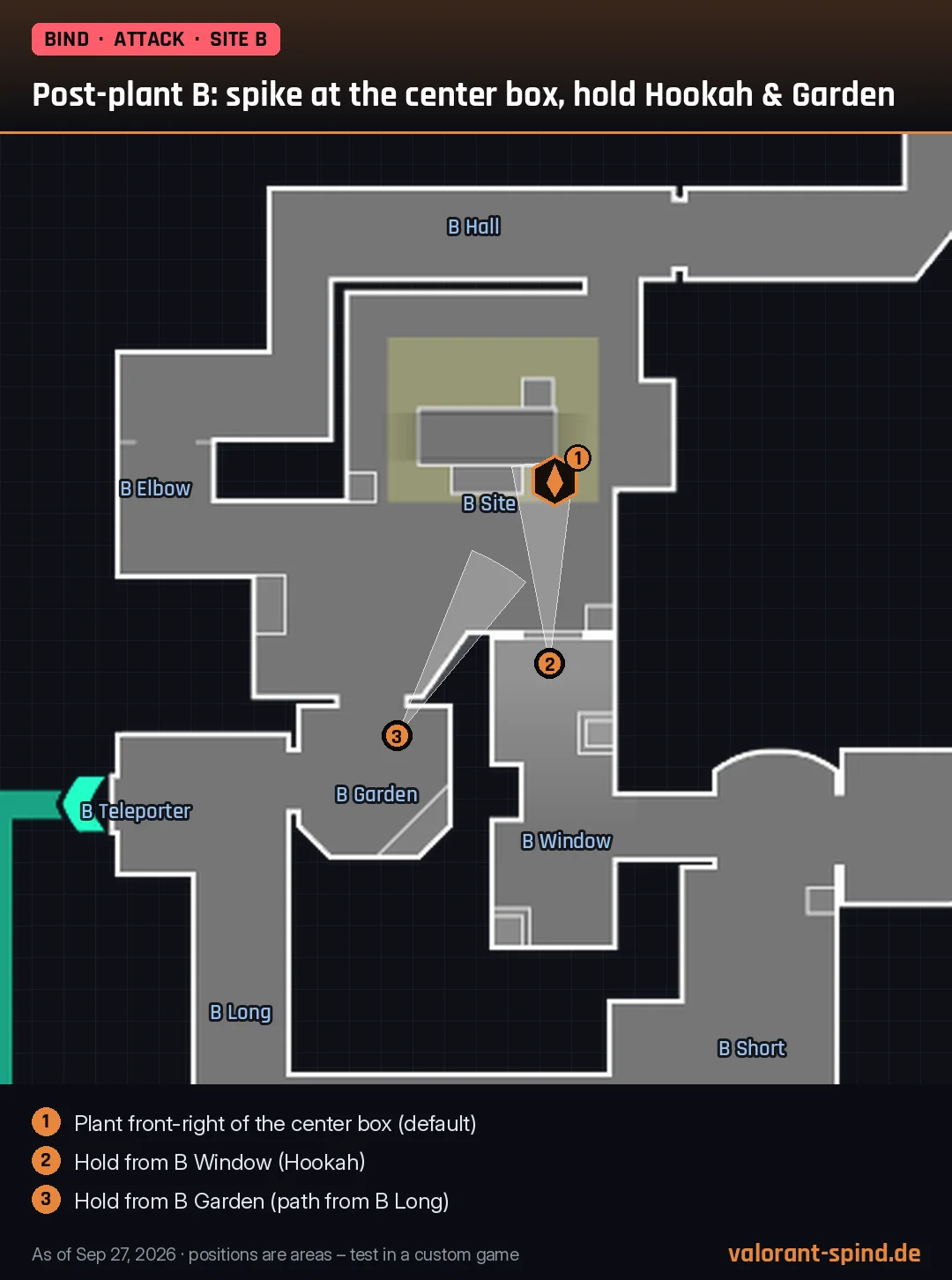
Post-plant with teleporter info: after the plant, the teleporter sound is your friend. When you hear a teleport, you know defenders are on their way – and roughly which direction they’ll come from.
A proven pattern on Bind is the split take on B: two players come through B Short and B Window, three through B Long and B Garden. The B defenders then have to hold Window, Garden and Elbow at the same time. Timing is everything – if one group is late, you’ll be playing into a well-prepared retake. Practice these plays beforehand on the strategy board so everyone knows when to go.
On A, a grouped hit through two entrances often works: smoke A Tower and A Lamps, flash over A Short, then go through A Short and A Bath onto the site at the same time. Keep an eye on the A Exit next to A Bath: if a defender takes the teleporter from B Long, they pop up right in your flank. One player watching that area after the take saves plenty of rounds.
Defending on Bind: tips for the defender side
As a defender on Bind, you have a structural advantage: you hear every teleport. Used well, the map itself gives you more information than any camera. At the same time, without a mid the paths between the sites are long, so you need to weigh carefully when to rotate.
Listen for the teleporters: every teleport creates an audio cue for all players. Call the sound out to your team, but don’t rotate blindly – a single teleporter sound can be bait.
Control the exits: exit room doors only open from the inside. If you watch an exit, you see when someone comes out, and you can shoot through the door. That makes B Exit and A Exit strong information spots.
A Tower and B Hall as fallbacks: both positions are close to defender spawn. From there you can hold the site without standing too far forward, and you can get back to your team quickly if the attack hits the other side.
Don’t give up the short routes for free: attackers reach the sites fastest through A Short and B Short. Early contact with utility – such as Cypher’s Trapwire or Killjoy’s Alarmbot – slows the push down and buys your team time.
Play retakes together: without a mid, the walk from one site to the other is long. Group up behind spawn before the retake instead of trickling into the post-plant one by one.
Watch your own teleporter rotation: when you take a teleporter yourself, the attackers hear it just as you hear theirs. A rotation through the teleporter from B Long to A Lobby gets you to the A side quickly – but it also announces you. Decide whether the fast route is worth the sound, or rotate through the back via spawn.
Here are the key Bind setups to copy – no video needed: every position is marked on the official minimap, numbered and explained step by step. Bind is currently out of the competitive pool, so the picks follow the most-played recent pro comp: Brimstone and Viper as the double controller (in 89% and 92% of recorded comps), with no sentinel.
Every Bind setup on this page is backed by at least two matching sources. Pick a setup on the map – it zooms straight to the right spot. Important: the markers show the area, not the exact pixel. Try each setup once in a custom game before you use it.
A Bath, A Lobby, A site and the B entry from spawn were reworked before Bind returned in patch 6.08 (April 2023), so A setups use 2023+ sources only. Bind has been out of the pool since 12.08 – agents follow the last pro comp (Brimstone + Viper, no sentinel).
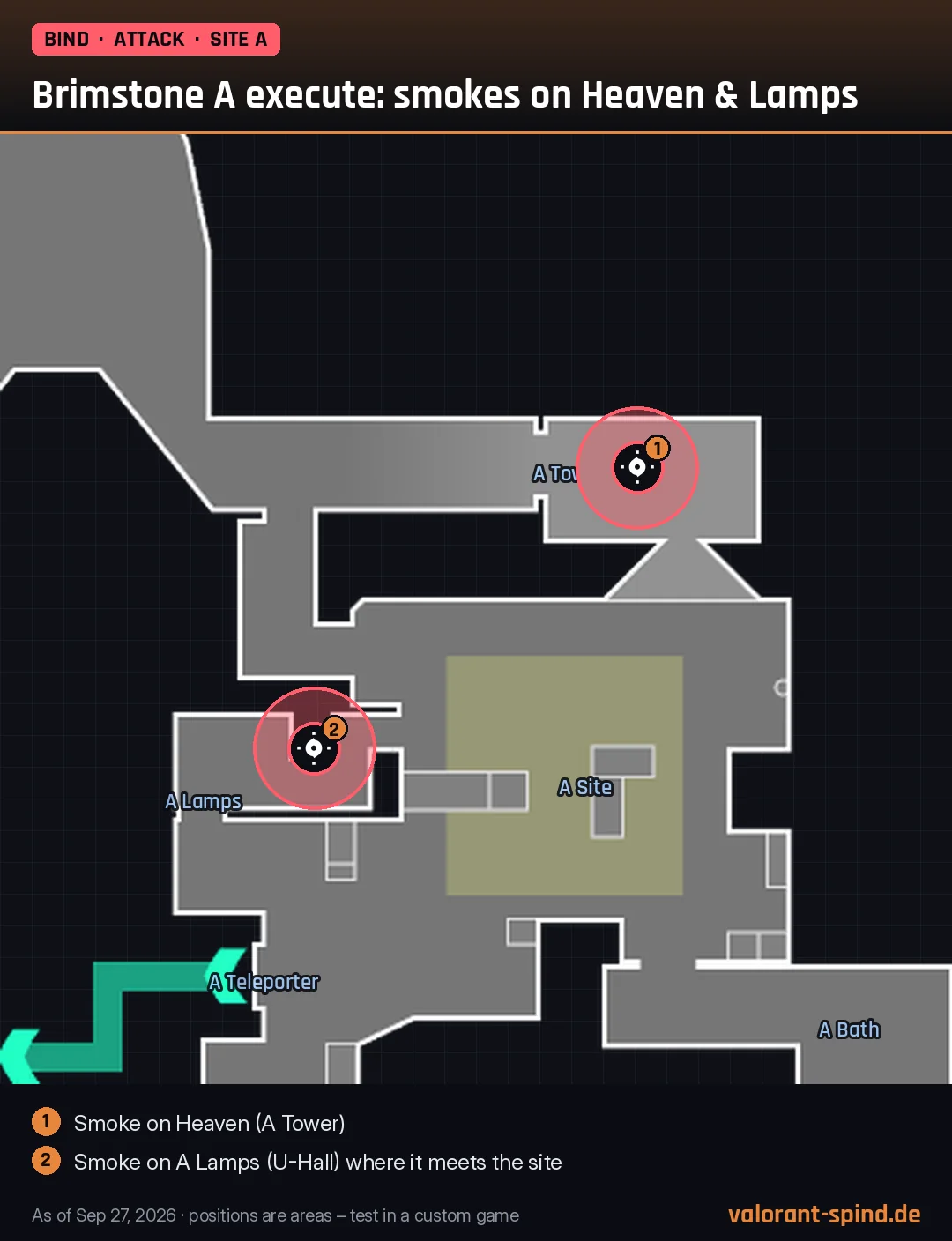
1Smoke 1: Place one Sky Smoke on Heaven (A Tower) behind the site. Otherwise defenders there look straight at A Short and A Bath.
2Smoke 2: Place the second Sky Smoke on A Lamps (community: U-Hall), where the corridor on the left opens onto the site. It cuts the back half of the site off from the front.
+Tip: Brimstone has three Sky Smokes – keep the third one flexible, e.g. against a rotation from Defender Spawn or for the retake.
Covers: The high angle (Heaven) and the link through A Lamps – the two key defender spots on A.
Weak spot: The corners behind the crates on site stay open, and every teleporter sound gives your attack away – clear with initiator utility first.
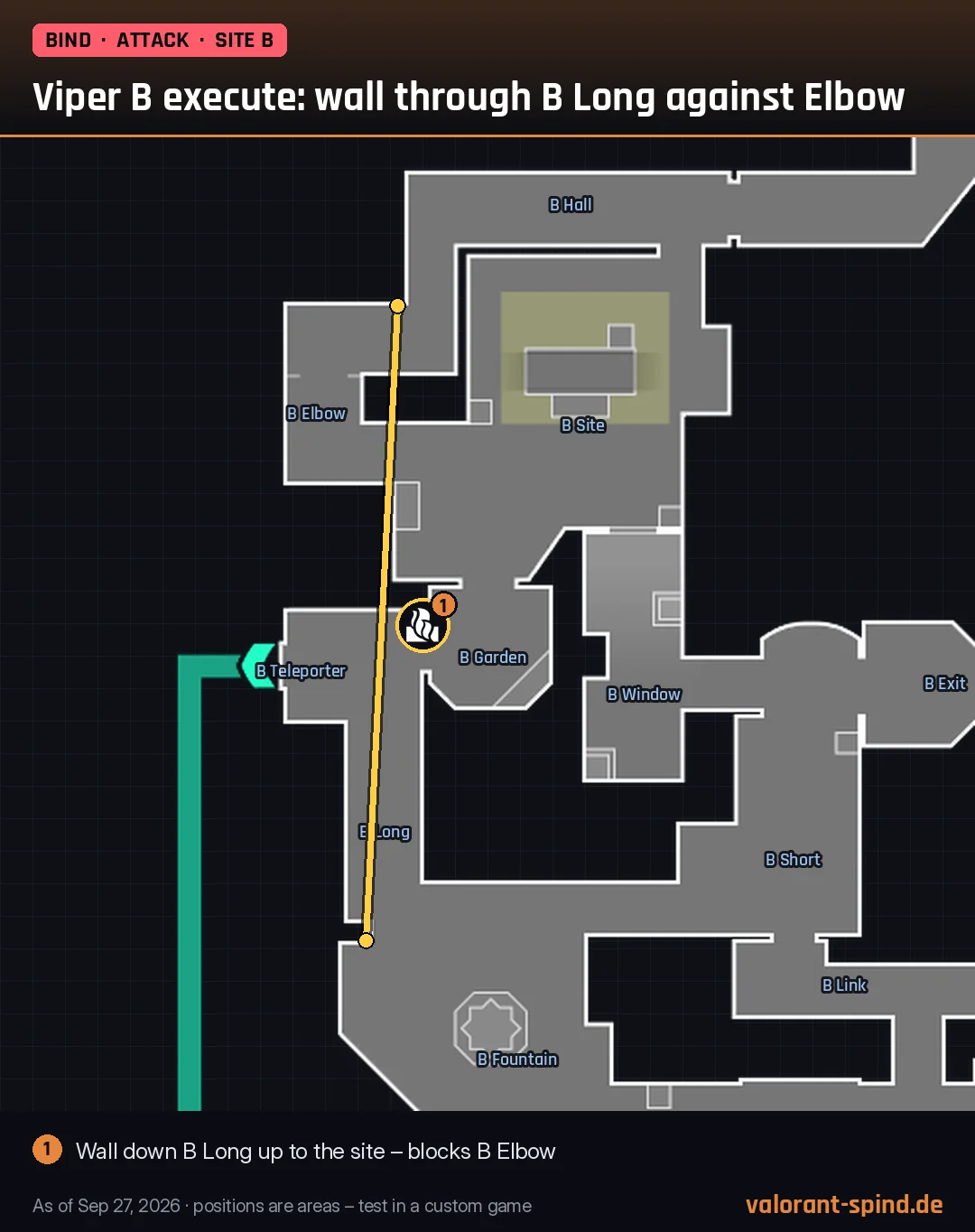
1Wall: Viper stands in B Long and throws the Toxic Screen straight toward the site. The wall splits B Long in two and runs up to the site, so defenders in B Elbow can't see the plant.
+Tip: Anyone who wants to keep playing from B Elbow has to cross the wall – you hear and see them first.
Covers: The angle from B Elbow onto the site and onto the path through B Long/B Garden.
Weak spot: B Window (Hookah) and B Hall are on your side of the wall – cover those angles with a second controller (Brimstone) or a flash.
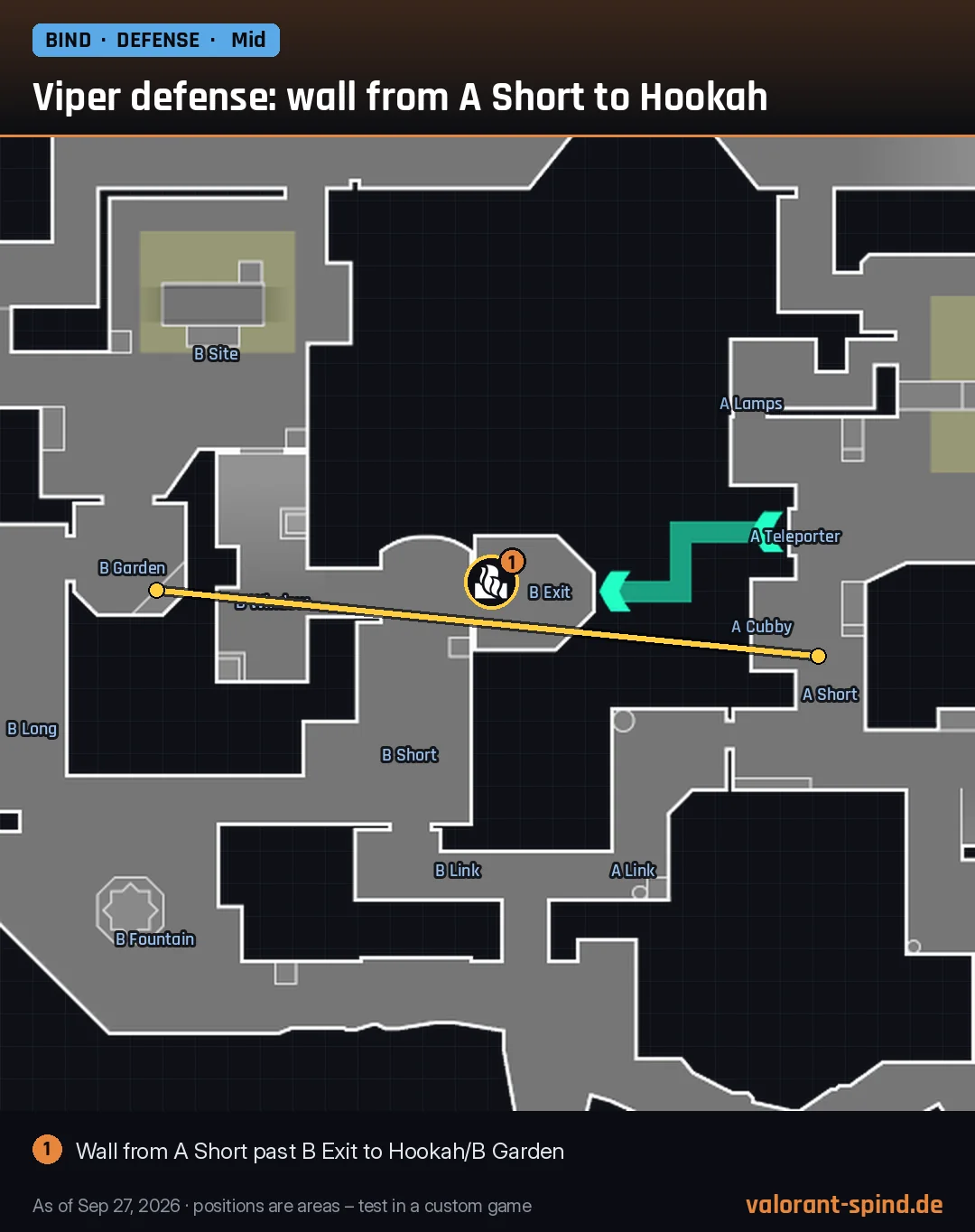
1Wall: Stand in A Short by the stacked crates (or, mirrored, at the entrance to B Window/Hookah) and throw the Toxic Screen across the middle of the map. It covers A Short, the B Exit room and Hookah plus B Garden.
+Tip: Raise the wall early in the round: attackers have to walk through the gas if they want to switch quickly between A and B.
Covers: Fast attacker rotations through the middle (A Short, B Exit, Hookah).
Weak spot: The wall also blocks your own view of Hookah. An attack through A Bath or B Long bypasses it completely.
Bind isn’t in the Competitive pool right now, but you’ll find it in custom games and you’ll see it again once it returns. This selection is based on the pro comp and on the map’s layout with tight sites and two teleporters:
For ranked teams without perfect comms, Trapwire, Spycam or Alarmbot lock down a site and the flank – and Bind is Cypher’s home.
The agent test tells you which agent fits your playstyle on Bind. For the overall ranking of all agents, check the agent tier list.
The 5 most common mistakes on Bind
Most rounds on Bind aren’t lost to bad aim but to poor decisions around the teleporters. Fix these five mistakes:
Chasing every teleporter sound: the cue tells you that someone teleported – not that the whole enemy team is coming. Rotate on every sound and you leave your own site empty.
Forgetting the teleporters are one-way: you can’t come back through the same teleporter. If you teleport to B Short and then want to play A after all, you need the long way or the teleporter from B Long.
Running blindly out of the exit room: the door only opens when you walk toward it, and it can be shot through. Defenders know exactly where you’ll come out. Without utility, that’s a duel you’ve announced in advance.
Not watching A Exit and B Exit: both exits lead straight into the flank of a site. If you only look forward after a take, you’ll get surprised from the exit room.
Vague callouts: “one at B” helps nobody. “One B Garden, low” wins rounds. Use the map above until all 24 names stick.
Callout cheat sheet: what good calls sound like on Bind
A good callout answers three questions in one sentence: how many, where, and in what state. On Bind there’s a fourth: who teleported? The following examples use only names from the official map:
“Teleporter A Short, one coming B Exit” – someone took the teleporter from A Short and is about to appear next to B Short.
“Two B Long, one taking teleporter” – pressure on B Long, one enemy is heading toward A Lobby.
“One A Exit, flank” – an enemy is coming out of the exit room next to A Bath into your flank.
“Three A Short, one A Cubby” – the attack on A is on, one enemy is waiting in the small corner.
“B Window clear, one B Garden tagged” – clear info on two entrances to B, one enemy is damaged.
“Spike A Site, I’m holding A Tower” – the spike is down, and you call your own post-plant position.
Two rules make the difference on Bind: first, call it out when you teleport yourself – otherwise your team will mistake your sound for an enemy rotation. Second, separate sound from sight: “heard teleporter” is different info from “saw one in B Exit”. Both are valuable, but only the second confirms where the enemy actually is.
Bind compared to the other maps
Bind is the map without a mid: where Ascent revolves around an open, branching mid and Lotus around three sites with rotating doors, Bind comes down to how well your team reads the two teleporters. On Bind, every teleport is a public signal that both teams hear. Add relatively tight sites where two controllers have more impact than an extra sentinel, and you get a map with a rhythm all its own. The table shows all 13 maps at a glance:
Want to master Bind before the map returns to the pool? This short training plan combines the tools on Valorant-Spind:
5 minutes of map study: turn on “All names” above and go through the A side first, then the B side. Pay special attention to the four teleporter callouts A Teleporter, B Exit, B Teleporter and A Exit.
3 minutes of quiz: run the Bind callout quiz until you score at least 8 out of 10.
5 minutes in a custom game: walk through both teleporters, look at the exit rooms and test how the door reacts. Also throw an ability through a teleporter once.
2 minutes of tactics: for Bind, draw a teleporter fake on B followed by a hit on A on the strategy board and share it with your team.
After that, check out two maps with a completely different layout: Ascent with its doors and open mid, and Lotus with three sites and rotating doors. If you want to win the close-range duels on Bind, train your reactions and precision in the aim trainer.
Bind FAQ
How many callouts does Bind have?
The official Bind map has 24 callouts: 10 on the A side, 11 on the B side, 2 on the attacker side (Attacker Spawn and Attacker Cave) plus Defender Spawn. There are no mid callouts.
Is Bind in the map pool right now?
No. Bind has been out of the Competitive pool since patch 12.08 (April 28, 2026). Since patch 13.04, the pool consists of Ascent, Abyss, Haven, Lotus, Split, Summit and Sunset. You can still play Bind in a custom game.
How do the teleporters on Bind work?
There are two one-way teleporters: one from A Short to B Short and one from B Long to A Lobby. You walk into the entrance and instantly arrive in a small exit room whose door opens automatically, but only from the inside. The door can be shot through.
Can you hear when someone teleports on Bind?
Yes. Whenever an agent or an object uses a teleporter, all players on the map get an audio cue. That applies to both teams.
Can you throw the spike through a teleporter?
Yes. According to the official wiki, abilities, the spike and dropped weapons are teleported when they touch the entrance. They keep their velocity and can open the exit room door if they travel far enough.
Does Bind have a mid?
No. According to its official description, Bind is a map with two sites and no mid. The two teleporters act as fast connections between A and B instead.
When was Bind released?
Bind was already playable in the closed beta that started on April 7, 2020. Together with Haven and Split, it is one of Valorant’s first three standard maps.
Where is Bind set in the Valorant world?
Bind is set in Rabat, the capital of Morocco, on Alpha Earth, where the Kingdom Corporation runs a radianite refinery. According to the wiki, Rabat is also Cypher’s home.
What are the best agents on Bind?
The most-played pro comp on Bind is Neon, Waylay, Skye, Brimstone, Viper, with 10 of 36 recorded comps from VCT 2026 Stage 1 and Masters Santiago/London 2026. Viper and Brimstone are almost always there as a double controller.
What’s the fastest way to learn the Bind callouts?
Use the interactive map on this page with “All names” turned on, then the callout quiz until you score 8 out of 10, and walk through both teleporters once in a custom game. For every map, there’s the full callout trainer.
Where does Brimstone smoke on Bind?
For an A execute the Sky Smokes go on Heaven (A Tower) and A Lamps (U-Hall); for B on B Elbow and the entrance from B Hall (CT). Keep the third smoke for a rotation or the retake.
Where does Viper put her wall on Bind?
On attack, Viper throws the Toxic Screen from B Long toward the site so it cuts off B Elbow. On defense, a wall runs from A Short across the middle of the map to Hookah and B Garden.



 Brimstone
 Smoke 1: Place one Sky Smoke on Heaven (A Tower) behind the site. Otherwise defenders there look straight at A Short and A Bath.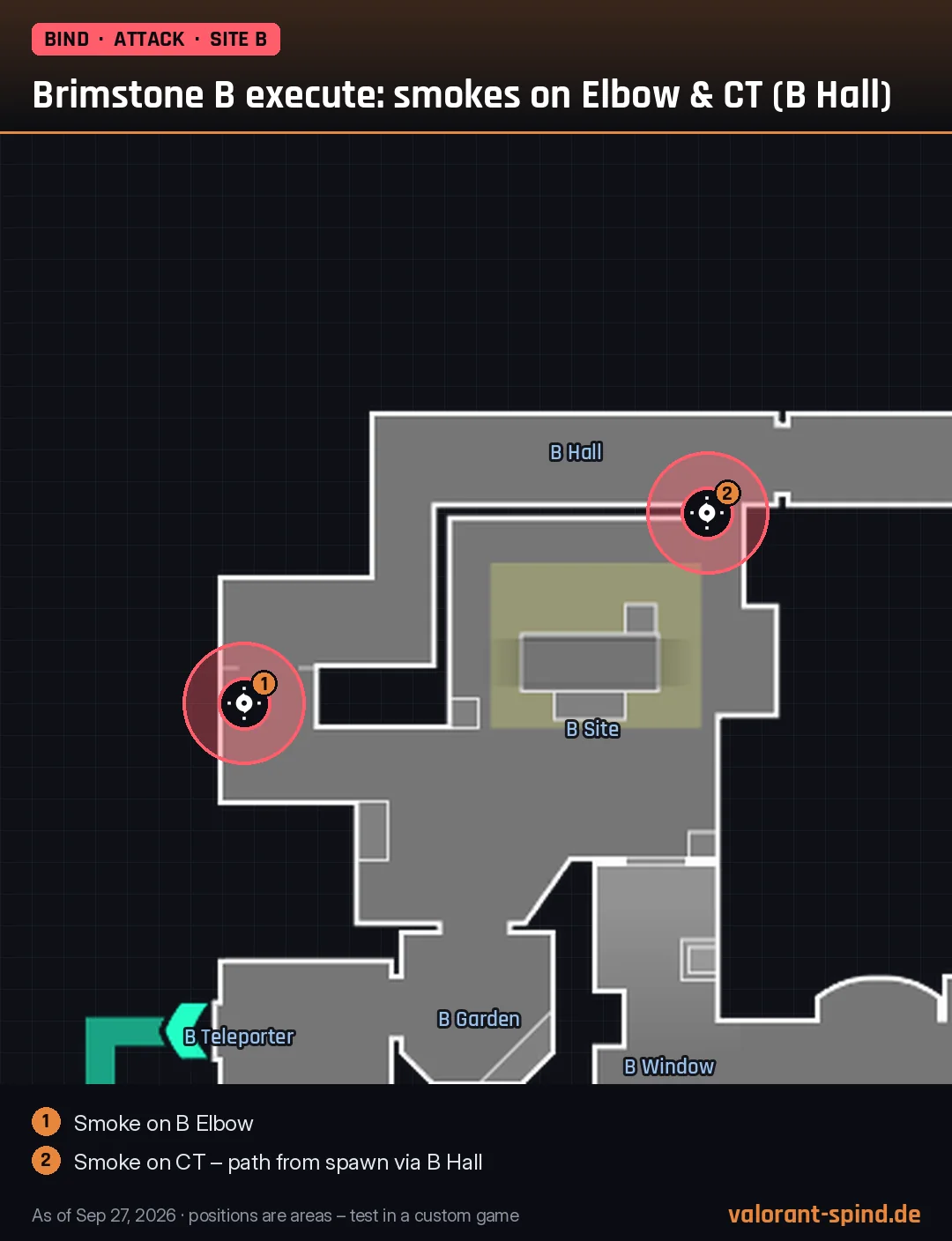
 Viper
Viper