All 22 callouts on the official map, the doors and panels explained, the pro meta with real numbers and concrete attack and defense tips – plus a callout quiz to learn Ascent in minutes.
New to Valorant? The app has your backLocker value in VP & euros and a coach with heatmaps – ideal alongside “Ascent guide”, 100% local, no login, free.
The official Ascent minimap from the Valorant API shows all 22 callouts in their real position. Tap your way around the map or test yourself in the callout quiz – so the names stick before your next match.
1Tap a dot or a name – the map shows the area and nearby callouts.
2Use the filters and “All names” to learn one area at a time.
3“Start quiz”: 10 random callouts, you tap the right spot.
What the map does for you
You make precise callouts in matches instead of “one back there”.
You understand where rotations run and which areas connect.
The quiz trains fast recall – exactly what counts in a match.
All positions come from the official map – no made-up names.
Tip: combine “All names” with a filter for one side to learn Ascent fastest – start with the side you play most, then the rest.
⚡ Quick answer
Ascent is a Valorant map with two spike sites (A and B) and three lanes, set in a floating chunk of Venice. The official map has 22 callouts. Its defining features are the wide, open mid and the two mechanical doors at A and B that defenders can close with a switch. Ascent has been back in the map pool since patch 12.08 and is part of the current Act V pool. In pro play, Omen and Sova are practically locked in on Ascent.
How to use the interactive Ascent map
Above you see the official Ascent minimap straight from the Valorant API – with all 22 callouts exactly where the game itself places them. Tap a dot or a name in the list and the map shows you the callout, its area and the nearest neighboring callouts. Use the filters to show only A, B, mid or the spawns. “All names” labels the entire map at once – perfect for memorizing it before your first match.
If you think you know Ascent, start the callout quiz: ten random callouts, you tap the right spot, and at the end you see your hit rate. This exact drill saves you the decisive second in a match, because a fast, precise callout is often worth more than a perfect flick. For all 13 maps and several difficulty levels, try the full callout trainer.
Ascent at a glance
Official Ascent splash artwork (source: Valorant API)
Property
Value
Release
June 2, 2020 · patch 1.0 (Episode 1, Act 1)
Setting
Venice, Italy – a floating part of the city
Spike sites
2 (A and B)
Lanes
3
Callouts
22 (official map)
Special feature
2 doors with 500 HP each, 2 destructible panels (400 HP each), glass window at A
In the pool
Yes – since patch 12.08 (April 28, 2026)
According to the Valorant Wiki, Ascent was actually the very first map Riot ever built – yet it only released with the official launch on June 2, 2020, after the beta maps Bind, Haven and Split. The setting is unmistakably Italian: in the background you can spot recreations of St. Mark’s Campanile and St. Mark’s Basilica. In Valorant’s story, a spike explosion ripped a huge piece out of Venice, which has been floating hundreds of meters up in the sky ever since.
Ascent’s mechanics: doors, panels and glass
At first glance Ascent plays like a classic two-site map, but it has three special features you need to know. All values come from the official Valorant Wiki.
The mechanical doors at A and B
Both spike sites have a heavy door with 500 HP. The A door sits on the connection between A site and mid (called “A Link” in callout lingo), while the B door separates B site from Mid Market. Both doors are open at the start of the round. A switch – right next to the A door, and on a table in the small shed at B – closes and reopens them. A closed door is impenetrable: no bullet goes through and attackers have to take another route.
Once a door is destroyed, it stays open for the rest of the round. That is where the tactical depth lies: defenders close doors to cut off a mid route and buy rotation time. Attackers shoot a door down on purpose when they need the mid path for their take or their post-plant. Remember the downside for defenders, too: a closed door doesn’t just block enemies – it also blocks your own rotations.
Destructible panels in mid
Between Mid Courtyard and Mid Link stand two destructible panels with 400 HP each. Their color shows their state: blue means intact, yellow damaged, red about to break. Once they are gone, new sightlines and wallbang options open up. That’s why teams like to shoot them down early in the round to make mid easier to read.
The glass window at A
A window with a single pane of glass leads into A Garden. It shatters from bullets and certain ability projectiles. Since patch 9.08, Jett’s Tailwind and Skye’s Trailblazer can also burst through the window. Abilities where the agent controls an object or places something on the ground don’t break the glass. A shattered pane often gives away that someone is rotating through Garden – listen closely.
Ascent rule of thumb: doors control rotations, panels open up mid, glass gives away movement. Keep these three things in mind and you’ll read Ascent faster than your opponents.
All 22 Ascent callouts explained
The table lists every Ascent callout from the official map with its area and the three spatially closest callouts. That way you instantly understand where a spot is when your team calls it. The table uses the names from the English client. Other language versions translate only a few terms – in German, for example, “Mid” becomes “Mitte” – so the callouts work with teammates from any region.
Callout
Area
Nearby
A Garden
A side
A Window, A Tree, Mid Pizza
A Lobby
A side
A Main, Mid Top, Mid Cubby
A Main
A side
A Tree, A Lobby, Mid Cubby
A Rafters
A side
A Site, A Window, A Garden
A Site
A side
A Rafters, A Main, A Tree
A Tree
A side
Mid Cubby, A Garden, A Main
A Window
A side
A Garden, A Rafters, A Tree
A Wine
A side
A Main, A Site, A Lobby
Mid Bottom
Mid
Mid Courtyard, Mid Market, Mid Pizza
Mid Catwalk
Mid
Mid Courtyard, Mid Cubby, Mid Top
Mid Courtyard
Mid
Mid Catwalk, Mid Bottom, Mid Link
Mid Cubby
Mid
A Tree, Mid Catwalk, A Main
Mid Link
Mid
Mid Courtyard, B Main, Mid Bottom
Mid Market
Mid
Mid Pizza, Mid Bottom, Defender Spawn
Mid Pizza
Mid
Mid Market, Mid Bottom, A Garden
Mid Top
Mid
A Lobby, Mid Catwalk, Mid Courtyard
B Boat House
B side
B Site, B Main, Mid Link
B Lobby
B side
Attacker Spawn, Mid Link, Mid Courtyard
B Main
B side
B Site, Mid Link, Mid Bottom
B Site
B side
B Main, B Boat House, Mid Market
Attacker Spawn
Attacker spawn
B Lobby, Mid Top, Mid Link
Defender Spawn
Defender spawn
Mid Pizza, Mid Market, A Window
A side: Lobby, Main and the site
Attackers gather in A Lobby and push through A Main onto the site. A Wine sits at the top edge of the map next to A Main and the site. At the back of the site is A Rafters – the elevated spot many players also call “Heaven”. To the left, A Window and A Garden lead toward defender spawn; this is where the glass window is. A Tree is the transition to mid and sits right next to Mid Cubby. That gives attackers two ways onto A: the classic route through A Main or through mid via Catwalk.
Mid: the heart of Ascent
No map in the current pool has such an open, branching mid. From the attacker side you come through Mid Top onto Mid Catwalk and on through Mid Cubby toward A. The wide open area in the center is Mid Courtyard, with Mid Bottom below it. On the defender side, Mid Market and Mid Pizza sit close together, and Mid Link connects mid to B Main. Whoever holds mid can turn to either site at any time – which is why almost every round on Ascent revolves around mid control.
B side: Main, site and Boat House
From B Lobby near attacker spawn, B Main leads straight onto B Site. At the bottom edge of the map is B Boat House – a corner defenders like to use for crossfires and post-plant retakes. The second route onto B goes through mid and Market, and that’s exactly where the B door sits. If defenders close it, attackers are left with B Main only.
Is Ascent in the map pool? Rotation history
Yes. Ascent has been back in rotation since patch 12.08 (April 28, 2026) and is also part of the pool used for Competitive since patch 13.04 (August 18, 2026): Ascent, Abyss, Haven, Lotus, Split, Summit and Sunset. In the past, Ascent was rotated out several times, most recently with patch 11.08 in October 2025. That’s normal: Riot rotates the pool regularly to keep the game fresh. You’ll always find the current status for every map on our Valorant maps & map pool overview.
Over the years Ascent has received many small but important tweaks: patch 10.04 made a wall section in B Main no longer wallbangable, patches 9.06 and 9.08 changed how abilities interact with the glass window, and since patch 6.0 doors can no longer be destroyed by abilities placed next to walls. Unlike Lotus or Split, Ascent never had a big rework – its core layout has been the same since 2020.
Ascent pro meta: who gets picked
What do pros play on Ascent? The presence values show in what percentage of maps an agent was picked by at least one team. The numbers come from our pick rate overview (source: vlr.gg, VCT 2026 Americas Stage 2, 150 maps played).
Presence = share of pro maps played on Ascent in which at least one team picked the agent · data: vlr.gg, VCT 2026 Americas Stage 2 (150 maps in total)
Omen and Sova both sit at 100% – practically no pro team plays Ascent without them. The reason: Omen’s smokes (Dark Cover) cut off the open mid and the wide site entrances, and Sova’s Recon Bolt and Owl Drone deliver exactly the information that decides rounds on such an open map. Behind them come entry duelists Phoenix (57%) and Neon (53%), Cypher (50%) as sentinel, and Jett and Chamber with 37% each.
Ascent: Most-played pro comp (12 of 39) · source: vlr.gg, VCT 2026 Stage 2 (4 regions) + Champions 2026
The most-played pro comp on Ascent is Jett, Phoenix, Sova, Omen, Cypher – it appeared in 12 of 39 recorded comps (source: vlr.gg, VCT 2026 Stage 2 across four regions plus Champions 2026). The roles are clear: Sova scouts mid, Phoenix flashes for Jett’s entry, Omen smokes, and Cypher holds the flank with his camera and traps. Try your own variations in the team comp builder.
Attacking on Ascent: tips for the attacker side
As an attacker on Ascent, you decide almost every round in mid. Give up mid without a fight and the defense can hold both sites with very few players.
Contest mid early: even one or two players on Mid Top and Catwalk force the defense to invest resources in mid. With a Recon Bolt or a drone you’ll then know whether Market or Pizza is held.
Use two routes per site: hit A through A Main and through Catwalk/Tree, and B through B Main and through Market. A split push from two directions overwhelms defenders who only watch one entrance.
Watch the doors: if a door is closed, your mid route to that site is shut. Decide early whether you’ll shoot the door down – 500 HP costs ammo and time, so plan for it.
Clear Rafters and Heaven: on A, the elevated spot at the back of the site is the most dangerous. Smoke or flash A Rafters before you come through Main.
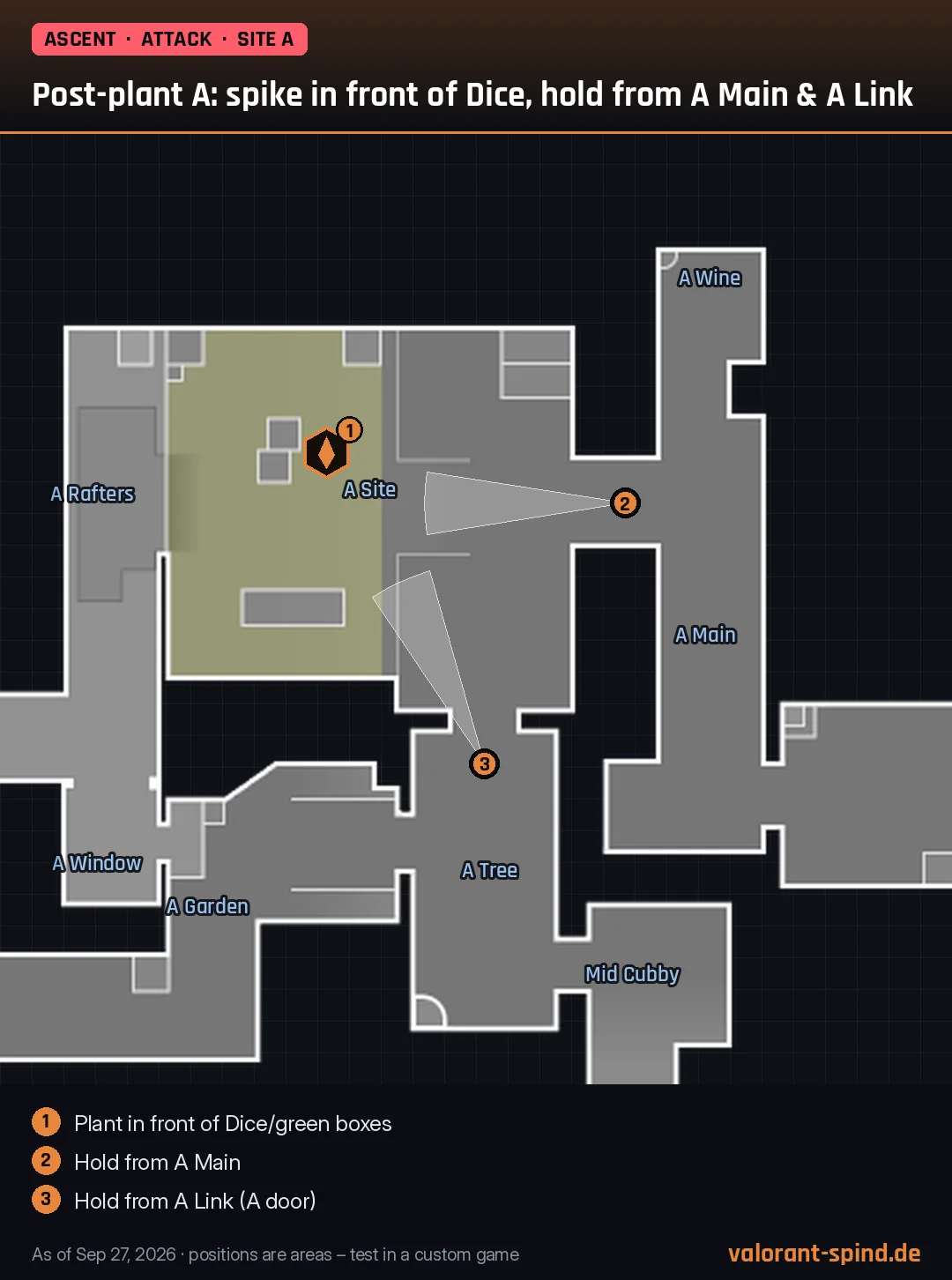
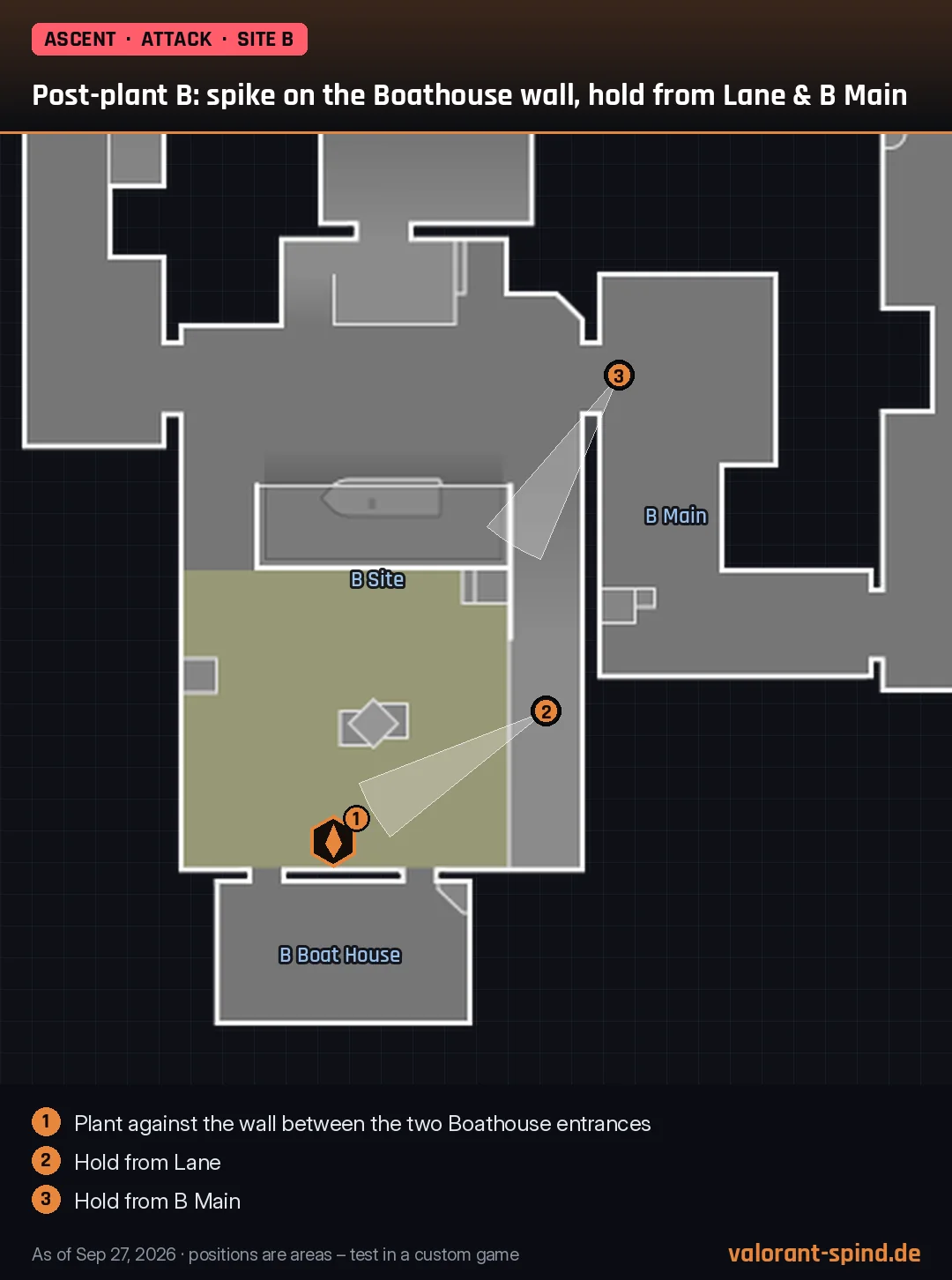
Pick your post-plant wisely: plant so you can hear and see the spike from safe angles – for example from A Main or from mid. Mollies and Nanoswarms on the spike win rounds without you having to peek.
A proven pattern is the mid split onto B: two players take control through Mid Market while three come through B Main at the same time. The B defenders suddenly find themselves in a crossfire. Timing is everything – if one group is late, you end up playing five isolated duels. Practice these plays beforehand on the strategy board.
On A, a fast, grouped hit through A Main often pays off instead: smoke A Rafters and toward A Tree, flash over the wall, then go in together. While the take is happening, one player holds Catwalk so no defenders can rotate out of mid into your flank.
Defending on Ascent: tips for the defender side
As a defender on Ascent you have one big advantage: the doors. Used well, they shrink each site down to a single attack route.
Don’t give up mid for free: one player in Market or Pizza with info utility – such as Cypher’s Spycam or Killjoy’s Alarmbot – stops attackers from quietly taking Catwalk or Courtyard.
Close doors situationally: if pressure comes through mid, close the door and force attackers onto the long route. If you’re rotating through mid yourselves, leave it open.
A Rafters as an anchor: the elevated spot at the back of A gives you a strong view of A Main. Don’t get greedy there – after the first kill, reposition.
B Boat House for crossfires: together with a player on site, Boat House creates an angle attackers can’t check from B Main at the same time.
Retake instead of stack: the rotation paths through mid are short on Ascent. Give up a site in a controlled way and retake it with grouped utility rather than stacking all five players on one side.
Watch the glass: if you rotate through A Garden and shoot or jump through the window, the enemy team hears the pane break. That gives away your rotation – use that path deliberately or go around quietly.
Ascent setups: Cypher, Omen smokes & post-plant
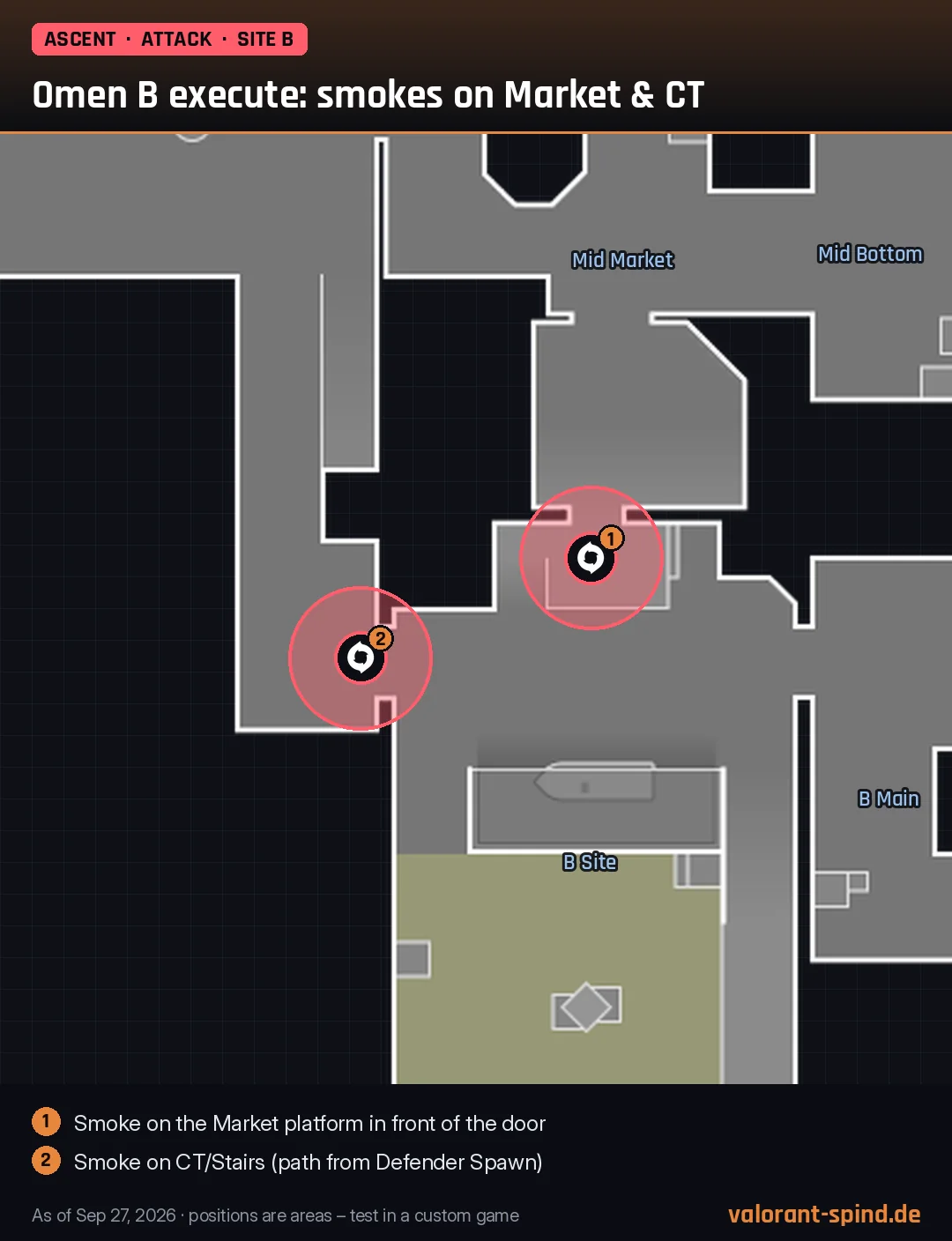
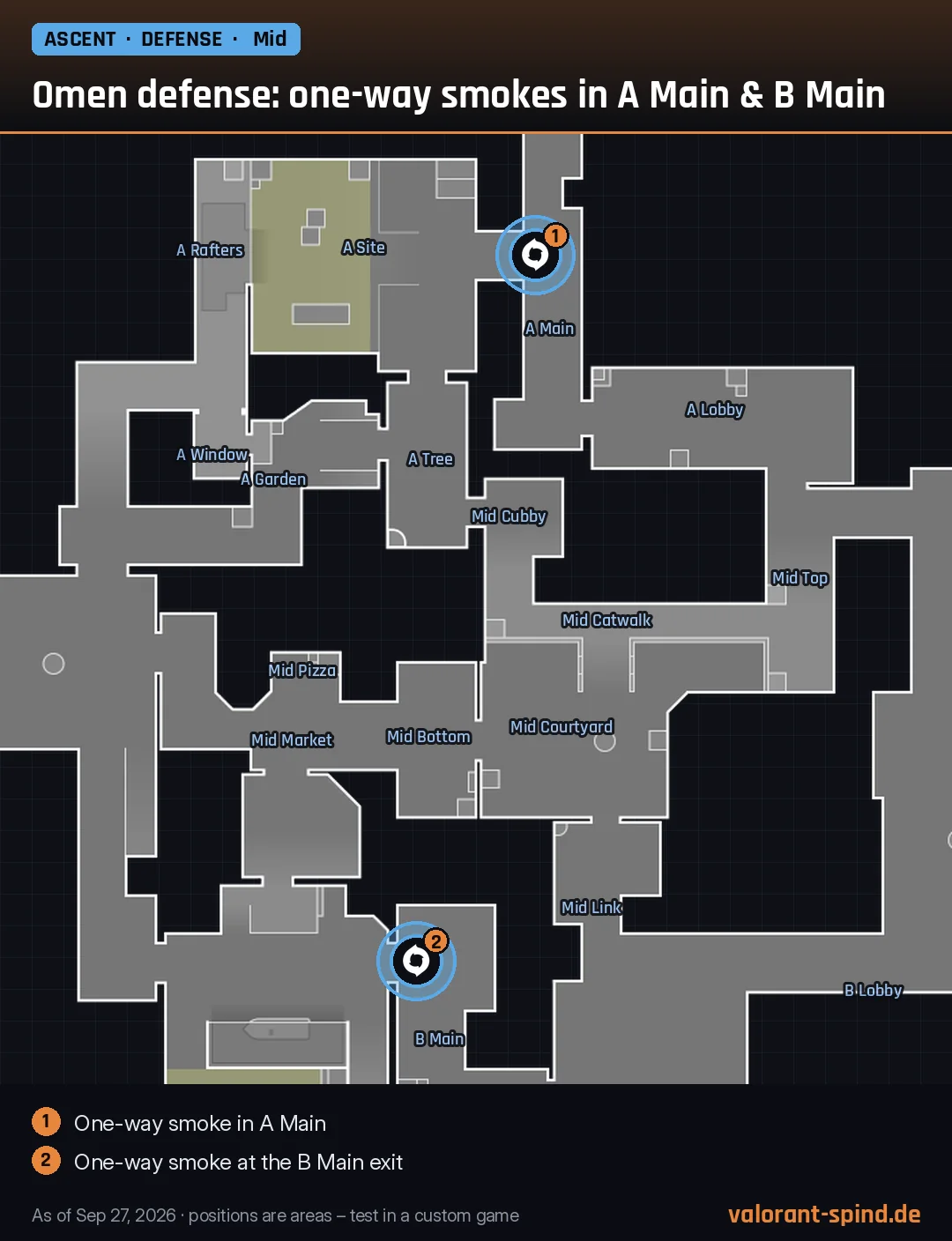
Here are the key Ascent setups to copy – no video needed: every position is marked on the official minimap, numbered and explained step by step. The agents are the ones actually played on Ascent in VCT 2026: Omen (100% presence) and Cypher (50%), plus the standard plant spots for the post-plant.
Every Ascent setup on this page is backed by at least two matching sources. Pick a setup on the map – it zooms straight to the right spot. Important: the markers show the area, not the exact pixel. Try each setup once in a custom game before you use it in ranked.
Geometry unchanged since patch 10.04 (only the B Main wall along B Lane made non-pennable). Agents picked by VCT 2026 presence on Ascent (vlr.gg): Omen & Sova 100%, Cypher 50%.
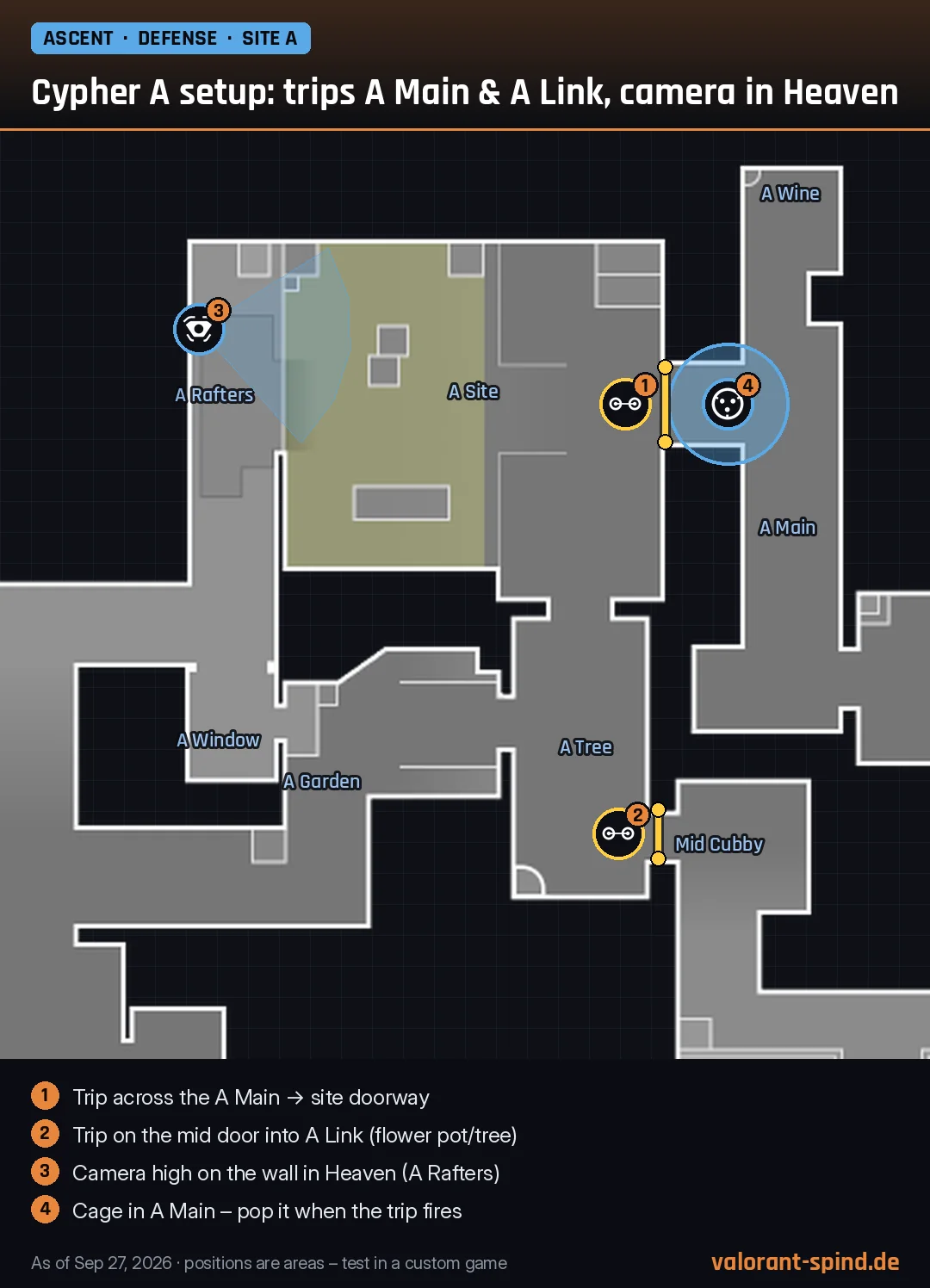
Cypher A setup: trips A Main & A Link, camera in Heaven
1Trip 1: Stand on the site side of the A Main doorway and aim the wire so its far end sits just past the door frame – that way nobody can shoot it safely from inside A Main.
2Trip 2: Anchor the wire at the mid door from Mid Cubby into A Link on the flower pot with the tree and angle it to the opposite wall. You now hear every Catwalk push through A Link.
3Camera: Go up to Heaven, aim high at the wall, jump and place the Spycam. It sees the whole site, the A Main entrance and A Link.
4Cage: Place the Cyber Cage in A Main in front of the doorway and pop it the moment the trip fires – attackers are tethered inside the smoke.
Covers: Info on both attacker routes (A Main + A Link) and vision on the plant.
Weak spot: Initiators (Sova dart, Fade) spot the Heaven camera quickly. Rotate the camera spot every 2–3 rounds.
1Trip 1: Anchor the wire on the right corner of the B Main doorway and stretch it across to right next to Logs. Anyone leaving B Main walks straight into it.
2Trip 2: Put the second wire very low in the Market door – it reveals flanks and rotations through Market.
3Camera: Stand on the Market platform, jump off and throw the Spycam high onto the wall of the building above Boathouse. From there you see B Main, Market and the plant.
4Cage: Drop the Cyber Cage into the B Main exit and pop it when the trip fires or the barrier drops.
Covers: B Main (main entrance), the Market flank and the whole site via the camera.
Weak spot: The B Main trip is well known – attackers often clear it with utility. Play with a teammate in Market.
Cypher and Killjoy lock down a site and the flank; Chamber holds long lines with Headhunter and Tour De Force.
The agent test tells you which agent fits your playstyle on Ascent. For the overall ranking of all agents, check the agent tier list.
The 5 most common mistakes on Ascent
Many rounds on Ascent aren’t lost to bad aim but to the same thinking errors. Avoid these five and you’ll win noticeably more rounds:
Ignoring mid completely: attacking only through A Main or B Main hands the defense mid – and fast rotations with it. Even one player with info utility in mid changes the round.
Forgetting the doors: a closed door nobody notices costs attackers valuable seconds when they suddenly have to turn around. Call it out when a door is shut.
Not checking Heaven: attackers often clear A Rafters too late. A single player up there can stop an entire take.
Too many players on one site: as a defender, a five-stack on Ascent is risky. The map rewards controlled retakes more than blind stacking.
Vague callouts: “one back there” helps nobody. “One Mid Pizza, low” wins rounds. Use the map above until all 22 names stick.
Callout cheat sheet: what good calls sound like on Ascent
A good callout answers three questions in one sentence: how many, where, and in what state. That’s all your team needs. The following examples use only names from the official map and show how short and precise a call on Ascent can be:
“Two A Main, one tagged” – two enemies are coming through A Main, one of them is damaged.
“One Catwalk, turning to Cubby” – an enemy in mid is heading toward A Tree.
“B door is closed” – the mid route through Market onto B is shut, attackers have to use B Main.
“Panels are down” – there’s now a clear view and wallbangs between Mid Courtyard and Mid Link.
“Glass broke, Garden” – someone is rotating through A Garden right now.
“Spike B Site, default” – the spike is in the usual spot on B.
Two rules make the difference: first, info first, emotions later – “one Pizza, 40 HP” instead of “how did he hit me?!”. Second, short and calm after you die: you can still see where the enemy is going, and that is exactly the info your team needs right now.
Ascent compared to every Valorant map
Ascent is one of the most open maps in the game. While Split, for example, works through height and tight paths and Lotus through three sites and rotating doors, Ascent is won above all by the team with better mid control. The table shows all 13 Valorant maps and their key differences at a glance:
Want to master Ascent quickly? This short training plan combines the tools on Valorant-Spind:
5 minutes of map study: turn on “All names” above and go through A, mid and B one after another.
3 minutes of quiz: run the Ascent callout quiz until you score at least 8 out of 10.
5 minutes in a custom game: walk Ascent in the game itself – A Lobby, A Main, Catwalk, Market, B Main – and look at the doors and switches.
2 minutes of tactics: for Ascent, draw a mid split onto B on the strategy board and share it with your team.
After that, check out the other two maps in this cluster: Split with its ropes and towers, and Lotus with three sites and rotating doors. If you also want to work on your aim, the aim trainer has matching drills.
Ascent FAQ
How many callouts does Ascent have?
The official Ascent map has 22 callouts: 8 on the A side, 8 in mid, 4 on the B side, plus attacker spawn and defender spawn.
Is Ascent in the map pool right now?
Yes. Ascent has been back in rotation since patch 12.08 (April 28, 2026) and is part of the Competitive pool since patch 13.04: Ascent, Abyss, Haven, Lotus, Split, Summit and Sunset.
How do the doors on Ascent work?
A and B each have a door with 500 HP that can be closed and opened with a switch. When closed it is impenetrable. Once destroyed, it stays open for the rest of the round.
Where are the door switches on Ascent?
The switch for the A door is right next to the door. You operate the B door with a switch on a table in the small shed at B.
Where is Ascent set in the Valorant world?
Ascent takes place in a part of Venice, Italy, that was ripped out of the ground by a spike explosion and has been floating hundreds of meters up in the sky ever since.
When was Ascent released?
Ascent came out with Valorant’s official launch on June 2, 2020 (patch 1.0, Episode 1, Act 1).
What are the best agents on Ascent?
In pro play, Omen and Sova are locked in with 100% presence each, followed by Phoenix, Neon and Cypher. The most-played pro comp is Jett, Phoenix, Sova, Omen, Cypher.
What is Heaven on Ascent?
Heaven refers to the elevated spot at the back of A site, which is called A Rafters on the official map. From there, defenders have a strong view of A Main.
Can you wallbang on Ascent?
Yes, in many places. The two panels between Mid Courtyard and Mid Link have 400 HP and open new wallbang angles once destroyed. Some spots, such as a wall section in B Main, have deliberately been non-wallbangable since patch 10.04.
What’s the fastest way to learn the Ascent callouts?
Use the interactive Ascent map on this page with “All names” turned on, then the callout quiz until you score 8 out of 10. For every map, there’s the full callout trainer.
Where do you set up Cypher on Ascent?
On A, place one Trapwire across the doorway from A Main to the site and one at the doorway from Mid Cubby into A Link; the Spycam goes high on the wall in Heaven. On B, put a trip on the B Main doorway (up to just before Logs), one low in the Market door and the camera high on the building above Boathouse.
Which smokes do you need for an A execute on Ascent?
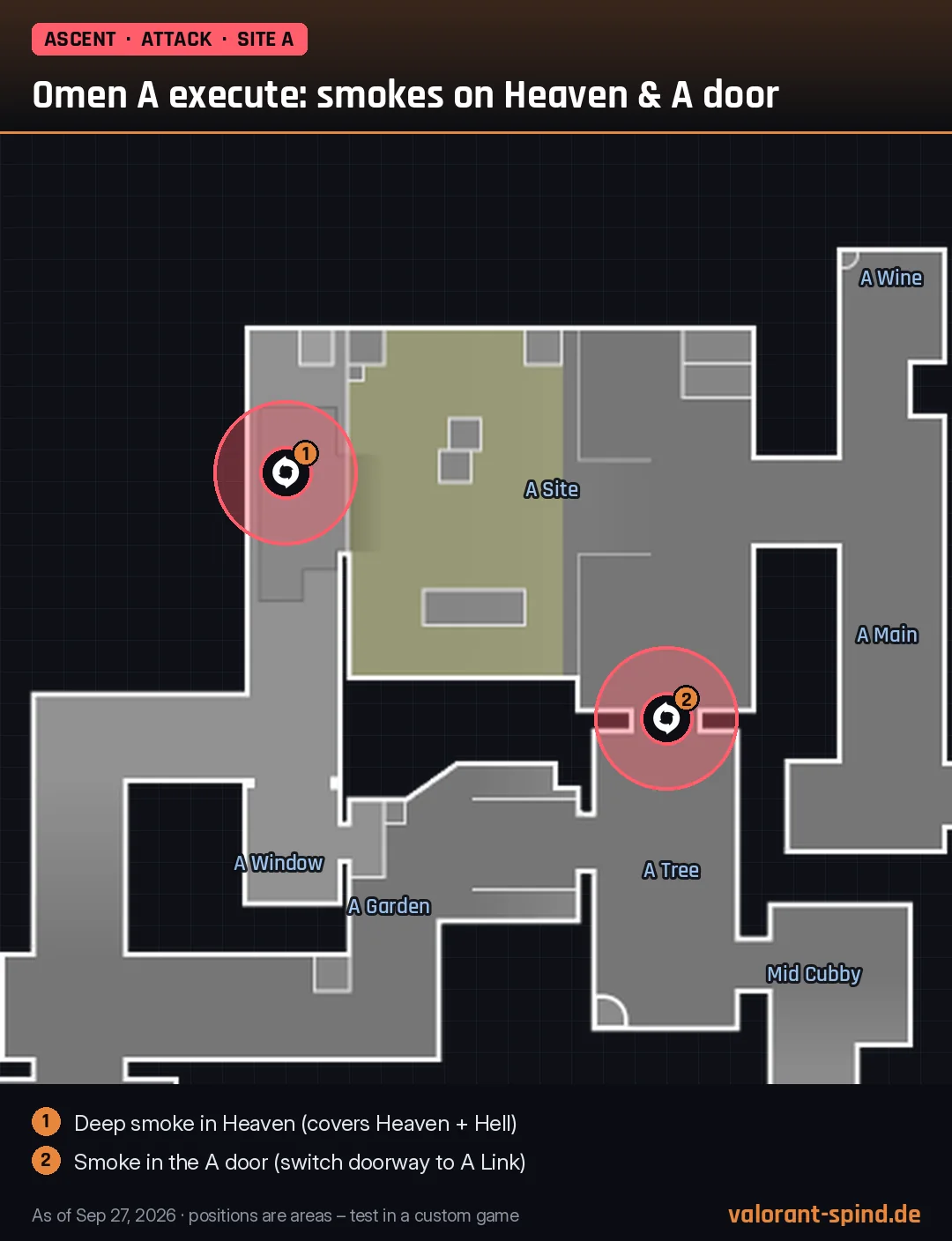
Omen smokes Heaven – deep, so Hell is blind too – and the A door by the switch that leads to A Link. For B it is Market and CT/Stairs.



 Cypher
 Trip 1: Stand on the site side of the A Main doorway and aim the wire so its far end sits just past the door frame – that way nobody can shoot it safely from inside A Main.
 Camera: Go up to Heaven, aim high at the wall, jump and place the Spycam. It sees the whole site, the A Main entrance and A Link.
 Cage: Place the Cyber Cage in A Main in front of the doorway and pop it the moment the trip fires – attackers are tethered inside the smoke.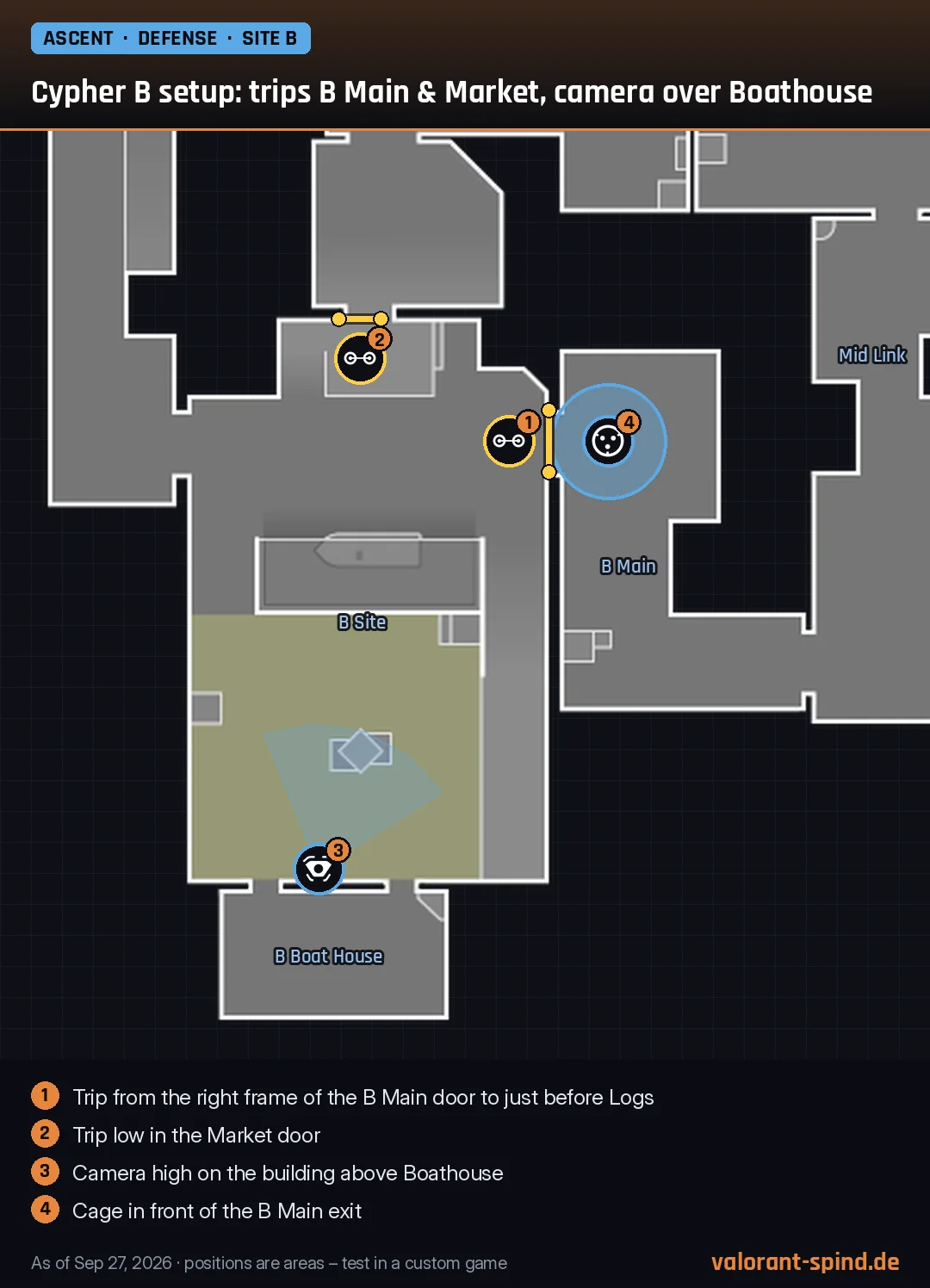
 Omen
Omen