All 25 callouts on the official map, ziplines, ropes and nests explained, the current pool status, the last pro comp and concrete attack and defense tips – plus a callout quiz to learn Icebox in minutes.
New to Valorant? The app has your backLocker value in VP & euros and a coach with heatmaps – ideal alongside “Icebox guide”, 100% local, no login, free.
The official Icebox minimap from the Valorant API shows all 25 callouts in their real position. Tap your way around the map or test yourself in the callout quiz – so the names stick before your next match.
1Tap a dot or a name – the map shows the area and nearby callouts.
2Use the filters and “All names” to learn one area at a time.
3“Start quiz”: 10 random callouts, you tap the right spot.
What the map does for you
You make precise callouts in matches instead of “one back there”.
You understand where rotations run and which areas connect.
The quiz trains fast recall – exactly what counts in a match.
All positions come from the official map – no made-up names.
Tip: combine “All names” with a filter for one side to learn Icebox fastest – start with the side you play most, then the rest.
⚡ Quick answer
Icebox is a Valorant map with two spike sites (A and B), set in a Kingdom Corporation port and research facility on a Russian island in the Arctic Ocean. The official map has 25 callouts. Its defining features are the horizontal ziplines at A, ropes up to elevated nests on both sites and plant zones with several levels of elevation. Icebox has not been in the Competitive pool since patch 11.04 (August 19, 2025), but you can still play it in custom games. In the last recorded pro phase, Viper and Killjoy were locked in on Icebox.
How to use the interactive Icebox map
Above you see the official Icebox minimap straight from the Valorant API – with all 25 callouts exactly where the game itself places them. Tap a dot or a name in the list and the map highlights the callout, shows its area and its three nearest neighboring callouts. Use the filters to show only A, B, mid or the spawns. On Icebox the B filter is especially useful: with 14 callouts, the B side is labeled more than twice as densely as A, and many names like Green, Yellow and Orange sound more like a paint box than a map.
The “All names” toggle labels the entire map at once. That instantly reveals Icebox’s basic pattern: attacker spawn sits on the left edge of the map, defender spawn on the far right, B takes up the top half of the map, A the bottom half, and the three mid callouts sit in between. If you think you know Icebox, start the callout quiz: ten random callouts, you tap the right spot, and at the end you see your hit rate. This small drill saves you the decisive second in a match, because on such an angular map a precise callout is often worth more than a perfect flick. For all 13 maps and several difficulty levels, try the full callout trainer.
A tip for returning players: because Icebox hasn’t been in the Competitive pool since August 2025, many players have simply forgotten the names. When the map comes back into rotation, the team that relearns the callouts first has the edge. Five minutes with the map and two rounds of the quiz are enough to refresh your memory.
Icebox at a glance
Official Icebox splash artwork (source: Valorant API)
Property
Value
Release
October 13, 2020 · patch 1.10 (Episode 1, Act 3)
Setting
Bennett Island, Arctic Ocean (Russia) · Kingdom port and research facility
Spike sites
2 (A and B)
Callouts
25 (official map)
Special feature
Horizontal ziplines at A, ropes to nests on both sites, plant zones with several levels of elevation
In the pool
No – out of the pool since patch 11.04 (August 19, 2025)
Icebox arrived on October 13, 2020 with patch 1.10, at the start of Episode 1, Act 3. According to the official patch notes, the map was initially available only in Unrated, Spike Rush and Deathmatch so Riot could fix bugs and performance issues during a two-week test phase; Icebox followed in the Competitive queue on October 27, 2020. Riot officially describes the map as a secret Kingdom excavation site overtaken by the arctic: two plant sites protected by snow and metal require some “horizontal finesse” – and if you take advantage of the ziplines, they’ll never see you coming. According to the Valorant Wiki, the map’s internal codename was “Port.”
The backstory is one of the most intriguing in the game. According to the Valorant Wiki, Icebox is located on Bennett Island in Russia’s Sakha region, far up north among the islands of the Arctic Ocean. Kingdom runs a container port and research facility there and is excavating the remains of an ancient warship trapped in the ice. The lore wiki describes it as a Japanese red seal ship from the Tokugawa era that carried suits of samurai armor. One of them stands outside the playable area in a sealed chamber above A site. After Yoru’s release, that chamber was broken into and the armor’s mask is missing – according to the wiki, it’s the very mask Yoru wears during his ultimate, and Yoru himself carried out the break-in. One more detail for explorers: the containers list Kingdom’s address as 12333 W Olympic Blvd. in Los Angeles – the real address of Riot Games’ headquarters.
Icebox mechanics: ziplines, ropes and elevation
Icebox has no doors, no rotating doors and no teleporters. Its special feature is movement: the map forces you to think horizontally along ziplines and vertically along ropes. All information in this section comes from the official Valorant Wiki and the official patch notes.
The horizontal ziplines at A
According to the Valorant Wiki, Icebox was the first map with horizontal ziplines. Split already had ropes for climbing up and down, but on Icebox you glide sideways across a site for the first time. You’ll find the ziplines at A site; the interactive map in the official wiki marks them with two points, one on the A Nest side and one on the A Site side. That’s exactly what Riot means by “horizontal finesse”: a player can use the zipline to switch to a position that would take much longer on foot, opening an angle the enemies don’t expect.
The catch: on a zipline you’re a moving but predictable target. Every opponent who knows the line knows where you’ll arrive. So use the ziplines preferably when your teammates have already tied up the exits with smokes, flashes or pressure – or at the moment the enemies are busy with something else.
Ropes and the nests on both sites
Besides the ziplines, Icebox has several ropes (ascenders) you can climb up and down. The wiki notes an important rule here: both sites have elevated nests that you reach via ropes – and you can plant the spike right on the floor of these nests. For the attack, that means extra plant options up high; for the defense, it means the spike isn’t always at ground level and a retake sometimes has to go up a rope first.
Plant zones with several levels
According to the wiki, Icebox was also the first map where a plant site has different levels of elevation. Riot itself wrote in the 1.10 patch notes: each site is a complex combat space with plenty of cover and verticality, and the map emphasizes skirmishes, sharp aim and adaptive play. In practice that means: on Icebox, pre-aiming at head height isn’t enough. Enemies can stand above you on containers or in nests, below you on the site floor, or behind crates at mid height.
Containers, crates and wallbangable cover
Icebox’s sites are built largely out of shipping containers and crate stacks. Riot has deliberately tightened things up here over the years. Patch 3.06 made a crate stack on B impenetrable so attackers could plant more safely. According to the wiki, patch 9.05 closed a gap in the A Pipes door frame that let players shoot through from Mid Boiler. Rule of thumb: not every crate stops bullets, but don’t rely blindly on wallbangs – a lot of cover was made solid on purpose.
Silent drop at B Kitchen
A detail from the official patch notes 8.0 (January 9, 2024): Riot adjusted the snow pile leading up to B Kitchen so that you can now silently drop off the boxes. On the map, B Snow Pile and B Kitchen sit right next to each other. For defenders, that’s a way to reposition quietly; for attackers, it’s a reminder that not every movement on Icebox can be heard.
Icebox rule of thumb: ziplines move you sideways, ropes take you up, and the nests add an extra floor to every site. If you only aim straight ahead on Icebox, you’ll lose to the enemy above you.
All 25 Icebox callouts explained
The table lists every Icebox callout from the official map with its area and the three spatially closest callouts. The distribution on Icebox is unusual: 14 callouts on the B side, 6 on the A side, 3 in mid, plus attacker spawn and defender spawn. The table uses the names from the English client. In the German client, only “Mid” is translated – Mid Boiler becomes “Mitte Boiler,” for example – while all other names are identical, so the callouts work with German-speaking teammates too.
Callout
Area
Nearby
A Belt
A side
A Pipes, A Nest, Mid Pallet
A Nest
A side
A Pipes, A Belt, A Site
A Pipes
A side
A Nest, A Belt, Mid Pallet
A Rafters
A side
A Site, A Screen, Mid Pallet
A Screen
A side
A Site, A Rafters, Mid Pallet
A Site
A side
A Rafters, A Screen, A Nest
Mid Blue
Mid
B Tube, Mid Pallet, B Snow Pile
Mid Boiler
Mid
B Kitchen, Mid Pallet, B Snow Pile
Mid Pallet
Mid
Mid Boiler, A Screen, Mid Blue
B Back
B side
B Fence, B Hall, B Hut
B Cubby
B side
B Yellow, B Green, B Garage
B Fence
B side
B Hall, B Back, B Site
B Garage
B side
B Green, B Cubby, Mid Blue
B Green
B side
B Garage, B Cubby, B Orange
B Hall
B side
B Fence, B Back, B Site
B Hut
B side
B Kitchen, B Back, B Snow Pile
B Kitchen
B side
B Snow Pile, Mid Boiler, B Hut
B Orange
B side
B Snow Pile, B Hall, B Tube
B Site
B side
B Snowman, B Hall, B Fence
B Snow Pile
B side
B Kitchen, B Tube, B Orange
B Snowman
B side
B Site, B Fence, B Back
B Tube
B side
Mid Blue, B Snow Pile, B Orange
B Yellow
B side
B Cubby, B Green, B Site
Attacker Spawn
Attacker spawn
B Garage, A Belt, B Green
Defender Spawn
Defender spawn
B Hut, A Rafters, B Kitchen
B side, attacker side: Garage, Green, Cubby and Yellow
From Attacker Spawn on the left edge of the map, B Garage is the closest callout. Just above it is B Green, further up B Cubby, and at the very top edge of the map B Yellow. These four callouts form the attackers’ approach to B. The color names come from the containers placed here – Riot itself refers to the “Green lane” and the “yellow container” in its patch notes. Patch 4.04 (March 1, 2022) reworked this area: the doorway from the attacker spawn building toward Green was moved to the first cubby, the Green lane was slightly widened, and a pocket near Yellow was extended to clarify the angles toward B site and Snowman.
B side, the site: Snowman, Fence, Hall and Back
B Site sits at the top edge of the map, to the right of B Yellow. B Snowman stands at the very top right next to the site. Below the site, B Hall and B Fence sit close together, with B Back to their right. That gives B defenders several positions in a tight space – and attackers have to check all of them. Patch 4.04 fundamentally reworked this site: according to the patch notes, the yellow container was adjusted and new crate stacks were added, the lower container was removed, the upper container’s doorway was widened and repositioned, the outer wall and crane structure were brought in toward the site, a building in back B was closed off, and the plant zone was adjusted, including a new planting option on a bridge.
B side, toward defenders: Hut, Kitchen, Snow Pile, Orange and Tube
Below B Back is B Hut, one of the callouts closest to Defender Spawn. Below that come B Kitchen and B Snow Pile, which border each other directly. Further left are B Orange and B Tube. B Tube is a tube passage bordering Mid Blue; with patch 8.0, the end of the tube got a window that overlooks mid and can see toward A site and defender spawn. At the same time, Riot added a storage container in attacker spawn that blocks the line of sight from spawn to B Tube. And patch 8.0 also removed the B Orange route closest to B Kitchen. Because all these callouts sit between B and mid, they are the hub for rotations to and from B.
Mid: Blue, Boiler and Pallet
Icebox’s mid is small – just three callouts. Mid Blue borders B Tube and sits furthest left. Mid Boiler is to its right, right next to B Kitchen. Mid Pallet sits a little further down and already borders A Screen. Mid therefore connects both sites: through Blue and Tube toward B, through Pallet toward A. Patch 4.04 simplified and narrowed the ramp at Boiler and added crates to the Orange lane to block dangerous sightlines under the tube.
A side: Belt, Pipes, Nest, Screen, Rafters and Site
The A side lies in the bottom half of the map and has six callouts. A Belt sits at the bottom edge of the map and is the A callout closest to Attacker Spawn. To its right come A Pipes and A Nest, which sit close together. On the site itself are A Site, with A Rafters to its right and A Screen above it, bordering Mid Pallet. The A side has a rework history too: patch 1.14 (December 8, 2020) lowered A Belt and connected it to the platform below with a ramp, added a see-through gate that can’t be passed from ground level, sloped a wall and replaced a double stack of radianite crates on site with a smaller object. Patch 4.04 later removed a head peek at the attacker-side pipes and lowered a doorway into A to prevent foot shots.
Is Icebox in the map pool? Rotation history
No. Icebox has been out of the Competitive rotation since patch 11.04 (August 19, 2025). The official patch notes put it plainly: Abyss is back in the Competitive and Deathmatch queues, Icebox is out of the Competitive and Deathmatch queues. The pool used for Competitive since patch 13.04 (August 18, 2026) doesn’t include Icebox either: it consists of Ascent, Abyss, Haven, Lotus, Split, Summit and Sunset. You can reliably still play Icebox in a custom game. In addition, Icebox was one of the maps in the limited-time mode “All Random One Site” with patch 12.00 (January 6, 2026).
The recent rotation history in brief, each step backed by the official patch notes: with patch 8.0 (January 9, 2024), Icebox was in rotation and received changes to B Green, B Tube, B Orange and attacker spawn. With patch 9.08 (October 22, 2024), Icebox left the Competitive queue together with Lotus. With patch 10.04 (March 4, 2025), Icebox returned together with Ascent. There was one hiccup during that stretch: after spawn issues that appeared in patch 10.09, the 11.00 patch notes say Icebox was re-enabled in Deathmatch and Escalation. Patch 11.04 ended its most recent pool run. Since patch 10.00, Riot has said maps rotate every act – so a return is always possible, but none has been officially announced. You’ll always find the current status of every map on our Valorant maps & map pool overview.
Notably, even though Icebox isn’t in the pool, Riot keeps maintaining the map. According to the Valorant Wiki, patch 13.00 fixed a visual issue with Viper’s Viper’s Pit on Icebox, and patch 13.02 fixed a bug that let Waylay clip into the walls of B Tube with Lightspeed and Refract. That’s a good sign for everyone hoping for a comeback.
Icebox pro meta: who gets picked
Because Icebox hasn’t been in the VCT pool so far in 2026, there are no current presence values for this map from the ongoing season – which is why you won’t find a presence table here like on the Ascent or Lotus guides. Our reference is the last major international event featuring Icebox: Masters Toronto 2025. We analyzed the team comps played there via vlr.gg. You’ll find current pick rates for the maps in the pool in our pick rate overview.
Icebox: Most-played pro comp (3 of 11) · source: vlr.gg, Masters Toronto 2025 (not in the 2026 VCT pool so far)
The most-played pro comp on Icebox was Jett, Sova, Omen, Viper, Killjoy – 3 of 11 recorded comps (Most-played pro comp (3 of 11) · vlr.gg: Masters Toronto 2025 (not in the 2026 VCT pool so far)). Another number says even more: Viper and Killjoy appeared in all 11 pro comps. Viper’s Toxic Screen splits the sightlines on the wide, multi-level sites, Sova scouts the heights and corners with Recon Bolt and Owl Drone, and Killjoy locks down the post-plant above all with Turret, Alarmbot and Nanoswarm. Omen adds Dark Cover as the second controller, while Jett uses Updraft to exploit the map’s verticality. Test your own ideas in the team comp builder.
One important caveat: 11 comps from a single event is a small sample, and the data is from June 2025. Agents have changed since then, and new agents have been added. The basic pattern – a wall controller, an info initiator and a sentinel for the post-plant – follows directly from the map’s layout, though, and should remain a good starting point if Icebox returns.
Attacking on Icebox: tips for the attacker side
As an attacker on Icebox, there’s one thing you have to solve above all: the many levels. Every site has positions above, beside and below you. Walk onto a site without a plan and you’ll get hit from an angle you didn’t check.
Information before the take: a Recon Bolt or an Owl Drone shows you whether someone is waiting at B Hall, B Fence or A Rafters. On a map with so much cover, scouting is half the take.
Block the high ground on purpose: smokes or a Viper wall on the elevated positions separate the defenders from each other. Then work your way forward level by level instead of checking everything at once.
Hit B from two directions: the classic route goes through B Garage, B Green and B Yellow. With pressure through mid via Mid Blue and B Tube, you also come in from the B Orange side. That forces B defenders to hold two entrances at once.
Hit A through Belt and Pipes: A Belt and A Pipes sit close together and offer two approaches onto A. A flash or smoke toward A Screen stops a defender from rotating out of mid into your flank.
Plan the post-plant with height: because you can also plant in the nests on Icebox, it pays to agree beforehand where the spike goes. A well-chosen plant forces defenders to conquer a rope or a level first.
A proven pattern is the slow build-up on B: two players take early control of B Green and B Yellow, one player holds mid at Mid Blue, and only once the information checks out does the team commit to the take. Because B, with 14 callouts, is the largest area on the map, a B hit needs more utility than an attack on A. Practice these plays beforehand on the strategy board.
On A, a faster, grouped hit often works better: the A side has only six callouts, and the routes from A Belt and A Pipes to the site are shorter. Control over A Screen is key here, because that’s where the site borders mid. Ignore Mid Pallet and you’ll often get surprised from behind after the plant. And remember the ziplines: a player who takes a different position via the zipline can hold an angle in the post-plant that the retaking team doesn’t expect – but only once the arrival point is safe.
Defending on Icebox: tips for the defender side
As a defender on Icebox, you benefit from height and from the abundance of cover. The art is using those advantages without becoming predictable.
Don’t hold B alone: the B side is big and has many entrances. A single defender gets overrun there quickly. A combination of sentinel utility and a second player in rotation range at B Hut or B Kitchen is much more stable.
Keep an eye on mid: Mid Blue, Mid Boiler and Mid Pallet connect both sites. An Alarmbot, a Spycam or a player with info utility there tells you whether the attackers are rotating through mid.
Use height, then move: elevated spots like A Rafters are strong, but every attacker knows them. Get a kill from above and then switch positions – Icebox has plenty of cover for that.
Reposition quietly: since patch 8.0 you can drop off the boxes at B Kitchen silently. Routes like that help you change positions without the enemy hearing it.
Retake with a plan for the nests: if the spike is in a nest, you have to go up first. Group up, use utility against the post-plant positions and go in together instead of climbing the ropes one by one.
Watch the ropes and ziplines: anyone hanging on a rope or zipline is a predictable target for a moment – and that includes you. If you have to climb a rope during a retake, send utility ahead first so nobody is waiting for you at the top.
In ranked especially, Icebox’s B side is often underestimated. Because it has so many callouts, defenders easily lose track of it. Agree before the round who holds which corner – one toward B Yellow, one at B Hall or B Fence, for example – and who rotates when in doubt.
Icebox setups: Killjoy & Omen smokes on A
Here are verified Icebox setups to copy – no video needed: every position is marked on the official minimap, numbered and explained step by step. Since Icebox is not in the 2026 VCT pool, the picks follow the last pro comp from Masters Toronto 2025: Killjoy and Omen were part of the most-played lineup.
Every setup is backed by at least two matching sources – that is why there are deliberately only setups for A Site, which has been unchanged for years. Pick a setup on the map – it zooms straight to the right spot. Important: the markers show the area, not the exact pixel. Try each setup once in a custom game.
Icebox has been out of the pool since patch 11.04; the A side is unchanged since the patch 4.04 rework, while B was last reworked in patch 8.0 – there are no sufficiently matching post-8.0 sources for B, so only A setups. Agents follow the last pro comp (Masters Toronto 2025, vlr.gg): Killjoy and Omen; Viper walls are missing because no wall line is documented precisely enough.
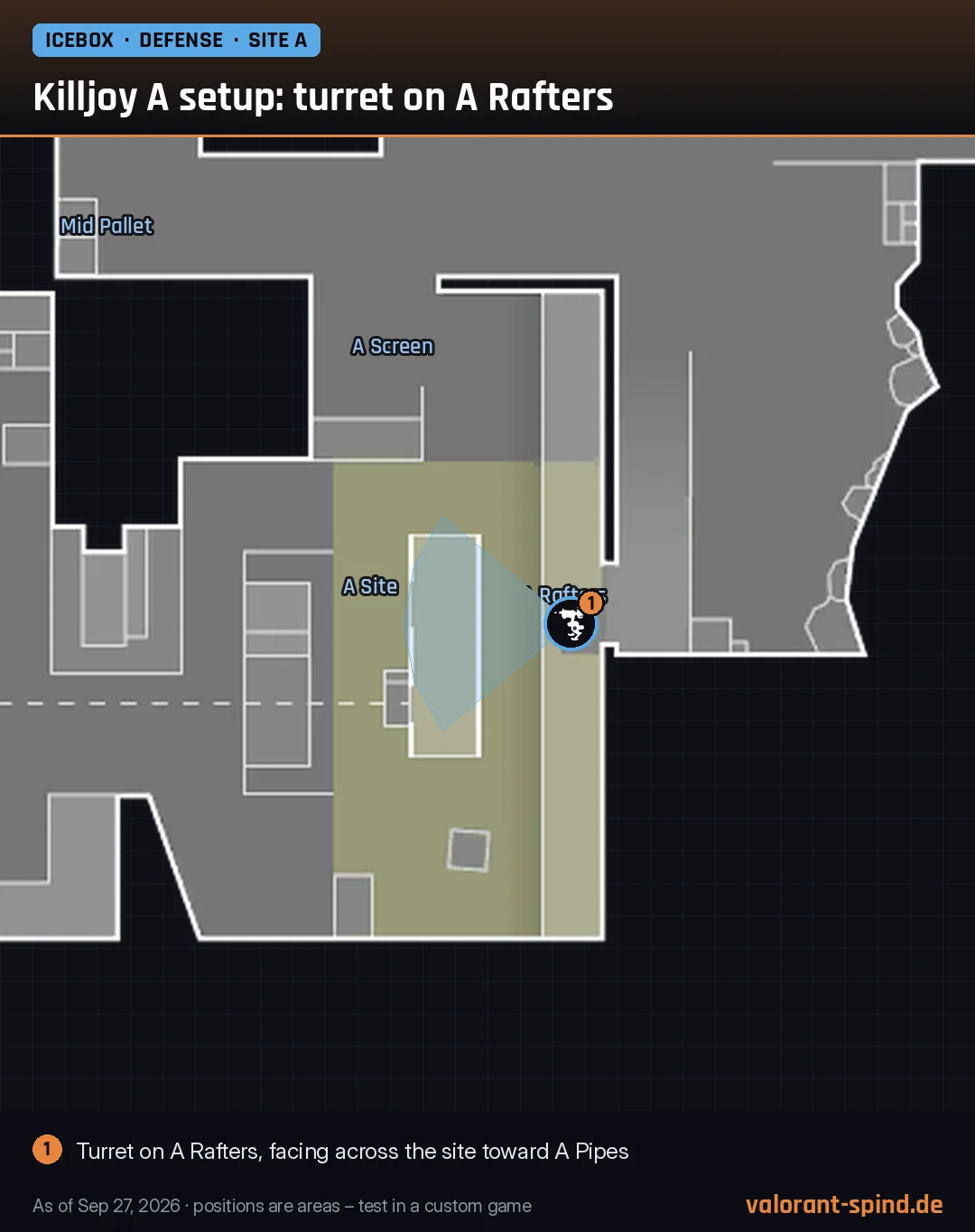
1Turret: Place the turret up on A Rafters at the back of the site and aim it across the site toward A Pipes. It flags every attacker coming out of A Pipes onto the site.
+Tip: the sources put the Alarmbot and Nanoswarms around the Maze and the default plant – the exact spots differ, so they are not drawn here. Pop the Nanoswarms when someone tries to plant on default.
Covers: Early info on the attack from A Pipes and A Belt without standing in the front line yourself.
Weak spot: On Rafters the turret is easy to find for initiators (Sova dart, drone). It does not cover A Screen toward mid.
You don’t need to copy a pro comp for ranked, but you should cover the roles. This selection is based on the pro data from Masters Toronto 2025 and the map’s layout:
Also in all 11 pro comps: Turret, Alarmbot and Nanoswarm lock down a site and, above all, the post-plant.
The agent test shows which agent suits your playstyle on Icebox. You’ll find the current overall ranking of every agent in the agent tier list.
The 5 most common mistakes on Icebox
Icebox punishes its very own mistakes. These five cost the most rounds in ranked:
Only aiming at head height: on Icebox, enemies stand on containers, in nests and behind crates at mid height. If you only look straight ahead, you die from above.
Zipline mid-fight: on the zipline you’re predictable. Use it while enemies can see the arrival point and you hand them an easy kill.
Underestimating B: with 14 callouts, B is the largest area on the map. A B hit without enough utility runs into too many open angles.
Forgetting mid: Mid Blue, Mid Boiler and Mid Pallet connect both sites. Ignore mid and you’ll get surprised from behind after the plant.
Vague colors: “one by the containers” helps nobody. “One B Yellow” or “two B Orange” wins rounds. Use the map above until all 25 names stick.
Callout cheat sheet: what good calls sound like on Icebox
A good callout answers three questions in one sentence: how many, where, and at what height. On Icebox, height is often just as important as location. These examples use only names from the official map:
“Two B Green, one going Yellow” – two attackers approaching B, one heading up toward B Yellow.
“One B Tube, coming Orange” – an enemy is using the tube from mid toward B.
“Mid Boiler clear, I’m rotating Kitchen” – mid is empty, you’re rotating to the B side.
“One A Rafters, high” – a defender is standing up high on A site.
“Three A Belt, Pipes empty” – the A attack is coming through Belt, the second route is clear.
“Spike B Site, Snowman side” – the spike is on B site toward B Snowman.
Two rules make the difference on Icebox: first, always call the height – “high” or “low” saves your team the second it would otherwise spend aiming at the wrong spot. Second, use the colors precisely: Green, Yellow and Orange sit in different parts of the B side. Mix them up and you send your rotation in the wrong direction.
Icebox compared to the other maps
Icebox is a two-site map with a small mid that draws its character from movement: ziplines at A, ropes up to nests on both sites and plant zones across several levels. Split also relies on ropes and height, but with towers and tight chokes; Ascent and Bind work with doors and teleporters respectively. The uneven distribution stands out too: no other of the 13 maps has as many callouts in a single area on the official map as Icebox with 14 on the B side. The table shows all 13 maps at a glance:
Want to get comfortable on Icebox fast – for custom games with friends or for its next return to the pool? This small training plan combines the tools on Valorant-Spind:
5 minutes of map study: turn on “All names” above and go through the areas one by one – first the 14 B callouts, then mid, then A.
3 minutes of quiz: play the Icebox callout quiz until you score at least 8 out of 10.
5 minutes in a custom game: walk Icebox in the game itself – B Garage, B Green, B Yellow, B Site, B Tube, Mid Blue, A Belt, A Site – and try out the ziplines at A and the ropes up to the nests.
2 minutes of tactics: for Icebox, draw a B hit through Green and Tube on the strategy board and share it with your team.
After that, take a look at two related maps: Split, the first map with ropes, and Fracture, where ziplines under defender spawn let attackers hit from two directions. And if you want to sharpen your aim for all those height angles, you’ll find matching drills in the aim trainer.
Icebox FAQ
How many callouts does Icebox have?
The official Icebox map has 25 callouts: 14 on the B side, 6 on the A side, 3 in mid, plus attacker spawn and defender spawn.
Is Icebox in the map pool right now?
No. Icebox has not been in the Competitive pool since patch 11.04 (August 19, 2025). The pool since patch 13.04 consists of Ascent, Abyss, Haven, Lotus, Split, Summit and Sunset. You can still play Icebox in custom games.
When was Icebox released?
Icebox released on October 13, 2020 with patch 1.10 at the start of Episode 1, Act 3. The map became available in the Competitive queue on October 27, 2020.
Where is Icebox set in the Valorant world?
According to the Valorant Wiki, Icebox is located on Bennett Island in Russia’s Sakha region in the Arctic Ocean. Kingdom runs a container port and research facility there and is excavating an ancient ship trapped in the ice.
Where are the ziplines on Icebox?
The horizontal ziplines are at A site. According to the Valorant Wiki, Icebox was the first map with horizontal ziplines.
Can you plant in the nests on Icebox?
Yes. Both sites have elevated nests that you reach via ropes, and you can plant the spike right on the floor of the nests.
When was Icebox removed from the pool?
Most recently with patch 11.04 on August 19, 2025, when Abyss came back. Before that, Icebox had already been rotated out with patch 9.08 in October 2024 and returned with patch 10.04 in March 2025.
What are the best agents on Icebox?
At Masters Toronto 2025, Viper and Killjoy appeared in all 11 recorded pro comps. The most-played pro comp was Jett, Sova, Omen, Viper, Killjoy.
What does the mask on Icebox have to do with Yoru?
Above A site, outside the playable area, a suit of samurai armor stands in a chamber. After Yoru’s release, the chamber was broken into and the mask is missing. According to the Valorant Wiki, it’s the mask Yoru wears during his ultimate.
How do I learn the Icebox callouts fastest?
Use the interactive map on this page with “All names,” then play the callout quiz until you score 8 out of 10. Start with the 14 callouts on the B side, since that’s where most of the names are.
Where do you set up Killjoy on Icebox?
On A the turret sits up on A Rafters at the back of the site, facing across the site toward A Pipes. The Alarmbot and Nanoswarms go around the Maze and the default plant.
Which smokes do you need for an A execute on Icebox?
Omen smokes the A Screen entrance so no rotation comes from mid, and A Rafters, the raised spot at the back of the site.



 Killjoy
 Turret: Place the turret up on A Rafters at the back of the site and aim it across the site toward A Pipes. It flags every attacker coming out of A Pipes onto the site.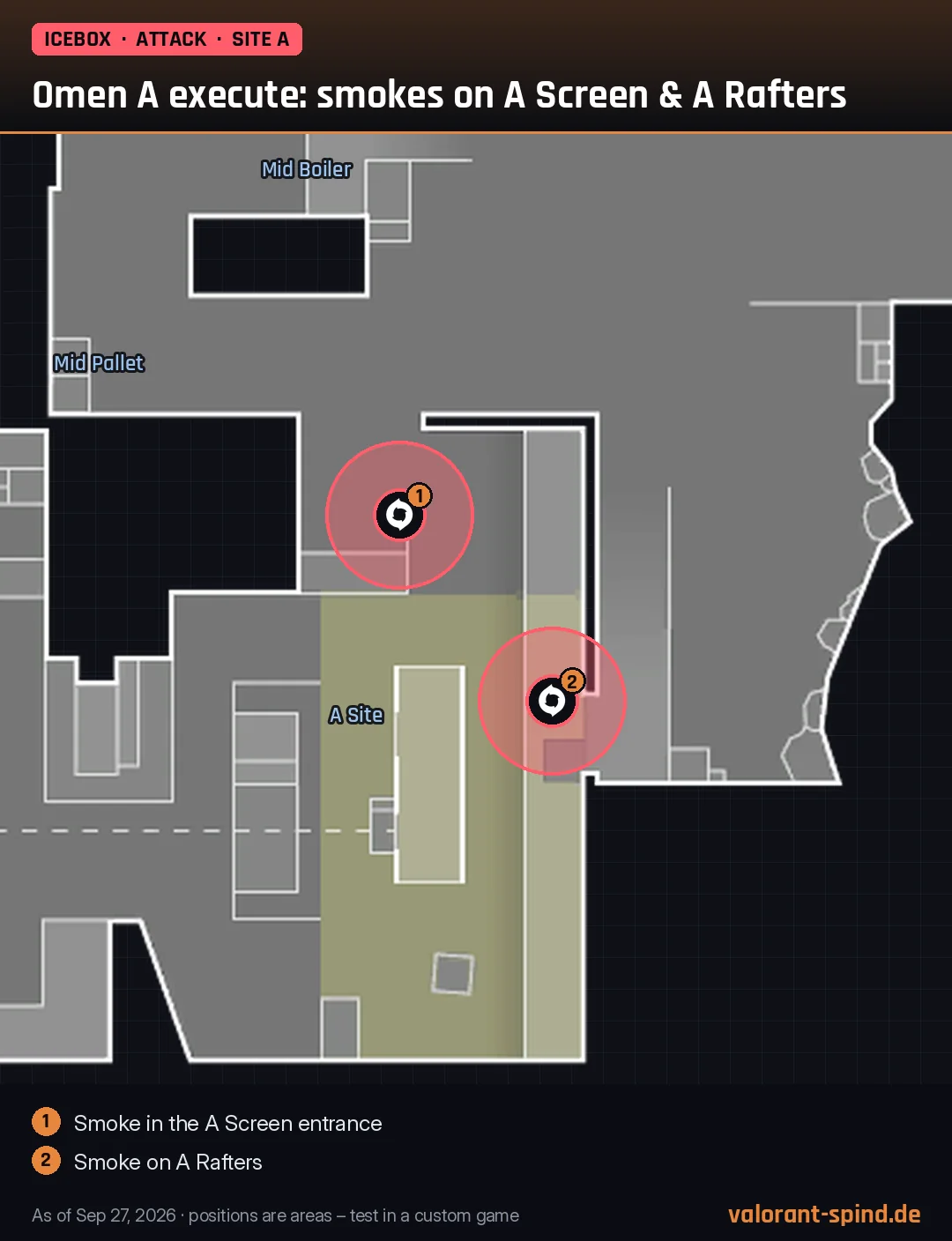
 Omen
Omen